I. INTAKE
A. Definitions
Abuse: means infliction of or threat to inflict physical pain or injury on or the imprisonment of any incapacitated adult or resident of a nursing home or other residential facility.
Adult Emergency Shelter Care Home: means a home that is available on a short-term, emergency basis for residential care type clients for whom no other appropriate alternatives currently exist, agreeing to accept placement on a twenty-four (24) hour basis.
Adult Emergency Shelter Care Provider: means an individual or family unit that has been certified by the Department of Health and Human Resources to provide support, supervision and assistance to adults placed in their home at any time on short notice.
Adult Family Care Home: means a placement setting within a family unit that provides support, protection and security for up to three individuals over the age of eighteen.
Adult Family Care Provider: an individual or family unit that has been certified by the Department of Health and Human Resources to provide support, supervision and assistance to adults placed in their home for which they receive payment.
Assisted Living Facility: referred to in state law as a “Residential Care Community”, is any group of seventeen or more residential apartments, however named, which are part of a larger independent living community, for the express or implied purpose of providing residential accommodations, personal assistance and supervision on a monthly basis to seventeen or more persons who are or may be dependent upon the services of others by reason of physical or mental impairment or who may require limited and intermittent nursing care but who are capable of self preservation and who are not bedfast.
Cognitive deficit: means impairment of an individual’s thought processes.
Emergency: means a situation or set of circumstances which present a substantial and immediate risk of death or serious injury to an incapacitated adult.
Incapacitated Adult: means any person who by means of physical, mental or other infirmity is unable to independently carry on the daily activities of life necessary to sustaining life and reasonable health.
| Social Services | Adult Emergency Shelter Care | |
|---|---|---|
| Manual | Request to Provide Services | Chapter |
| 37,000 | ||
Neglect: means the failure to provide the necessities of life to an incapacitated adult or resident of a nursing home or other residential facility with the intent to coerce or physically harm such incapacitated adult or resident of a nursing home or other residential facility or the unlawful expenditure or willful dissipation of funds or other assets owned or paid to or for the benefit of an incapacitated adult or resident of a nursing home or other residential facility.
Personal Care Home: A group living facility licensed by the Office of Health Facilities and Licensure and Certification (OHFLAC) providing 24 hour awake supervision of activities of daily living.
Personal Care Home Provider: A individual, and every form of organization, whether incorporated or unincorporated, including any partnership, corporation, trust, association or political subdivision of the state licensed by OHFLAC as a Personal Care Home Provider.
Residential Board and Care Home: A group living facility licensed by the Office of Health Facility Licensure and Certification to provide accommodations, personal assistance and supervision for a period of more than twenty four (24) hours to four or more individuals.
Residential Board and Care Provider: Any person and every form of organization, whether incorporated or unincorporated, including any partnership, corporation, trust, association or political subdivision of the State licensed by OHFLAC to maintain and operate a RB&C.
Physical deficit: means impairment of an individual’s physical abilities.
B. Introduction and Overview
Adult Emergency Shelter Care homes are placement settings for adults that provide support, supervision, protection and security in a family setting. This may be an appropriate option for individuals who are no longer able to safely remain in their own homes due to physical, cognitive, and/or emotional deficits. Although an individual may be experiencing deficits in one or more of these domains, the deficits are not significant enough to warrant the level of care provided in a nursing home.
The Adult Emergency Shelter Care provider must be certified by the Department of Health and Human Resources, Office of Social Services. Once certified, the provider may provide care for no more than a total of three adults. If a home is approved as a combination AFC/ESC home, the combined total of adults placed in the home shall not exceed three. The provider receives payment from the department for the care provided.
| Social Services | Adult Emergency Shelter Care | |
|---|---|---|
| Manual | Request to Provide Services | Chapter |
| 37,000 | ||
C. Eligibility Criteria
In order for an applicant to be approved as an Adult Emergency Shelter Care Provider they must
meet all following criteria:
C Age twenty-one (21) years of age or older;
C Submit a completed application packet;
C Willing and able to accept placements on a twenty-four (24) hour, seven (7) day a week
basis; and, C Meet all applicable standards for this type of setting.
Note: Approved Adult Emergency Shelter homes are expected to be available for three consecutive months followed by one month off. Payment of the monthly subsidy will continue uninterrupted.
D. Recruitment of Adult Emergency Shelter Care Providers
With the ever increasing need for supportive living options for vulnerable adults, it is important that the Department continues with recruitment efforts to locate new Adult Emergency Shelter Care Homes. Generally, when the local office receives an inquiry from someone in the community who is interested in becoming an Adult Emergency Shelter Care provider, an adult service worker will give/send the prospective provider an application packet which is to be completed and returned to the local DHHR office within thirty (30) days.
When additional Adult Emergency Shelter Care Homes are needed, the following steps are to be taken to develop a successful recruitment campaign.
C Identify number and type of homes needed; C Plan/develop information to be disseminated within the community to create an interest in the program; and, C Implement recruitment campaign.
There is a great variation from one community to the next, therefore these unique characteristics must be considered when developing a recruitment campaign. Some basic principles which apply generally have been identified and may be helpful in developing local programs. Individuals within the community must be made aware of the Adult Emergency Shelter Care Program and encouraged to seek more information. A variety of methods may be applied. The following are suggested approaches that have proven to be effective.
| Social Services | Adult Emergency Shelter Care | |
|---|---|---|
| Manual | Request to Provide Services | Chapter |
| 37,000 | ||
Note: In any recruitment initiative staff should follow the local protocol for this activity and should co-ordinate efforts with State Office staff/Office of Communications.
1. Newspaper Articles
Publicity through newspaper articles is a commonly used method of advertisement. Local newspapers generally are interested in supporting such community efforts. Ideally, there should be an initial article to generate interest and a follow up article a week to ten days later to provide more detailed information. There are various ways to present information in a newspaper such as:
a. Classified Advertising
This approach has not been commonly used because: (1) it tends to emphasize the potential for financial gain and (2) there is generally a cost associated with this option. This option may be useful in those areas where other forms of newspaper publicity have been exhausted. An example of an ad would be: “Are you looking for a new meaning and purpose for your life? Why not open your home to a person who is looking for the care and support of a family? Call the local Department of Health and Human Resources and ask about Adult Emergency Shelter Care Home Opportunities.”
b. News Release
This type of article simply announces the existence of a program and tells a little about it, including pertinent information such as the program name, the name of the agency, the name and phone number of contact person, etc. Also included in this advertizement would be news coverage of presentations to community groups and agencies.
c. Regular Columns
Many newspapers have regular columns on subjects of interest. The columnist usually becomes well-known and develops a following of readers. If the interest of a well-known columnist can be stimulated, he can be of tremendous help in developing community interest, as his approach to the subject will add the human interest touch which is usually lacking in a regular news article. The personal endorsement of the Adult Emergency Shelter Care Home Program will often cause the regular readers to consider it more seriously than they might otherwise.
d. Letters to the Editor
Letters written by local supporters of the program for publication on the editorial page of a local newspaper can be effective. This approach is most effective if it is written by a person who is well known in the community, but not associated with the Department. A local physician, attorney, politician or judge who has an interest in the program would be excellent. The worker, or supervisor, responsible for recruitment may have to seek out and educate them about the program. Often they will agree to have an agency representative draft the letter for their signature.
| Social Services | Adult Emergency Shelter Care | |
|---|---|---|
| Manual | Request to Provide Services | Chapter |
| 37,000 | ||
e. Feature Article
This is by far the most effective form of newspaper publicity, but it is also the most difficult to obtain. These articles often appear in “Sunday Supplement” or family sections of the newspapers and almost always include human interest items and pictures. They go into a considerable amount of detail and local adult service staff which are fortunate enough to be given this type of publicity should co-ordinate efforts with State Office staff/Office of Communication. This type of article is most effective in locations where some active Adult Emergency Shelter Care and/or Adult Family Care homes are already in operation. Written permission must be obtained in advance and a copy of this filed in the appropriate case(s) record. Location of the of the authorization is to be noted in Document Tracking of FACTS.
2. Radio
Radio exposure can be a useful tool for getting the Adult Emergency Shelter Care story to the community.
a. Spot Announcement
This approach probably reaches the greatest number of people, but often does not stimulate as much interest as is needed. It involves preparing a 30 - second spot announcement designed to encourage listeners to call for additional information. Radio stations will usually donate time several times a day for several days, as well as help with wording the announcement, if requested. The tape can be cut by an agency representative, but usually a professional announcer will be available for this, if needed.
b. Interview or Discussion Program
Most radio stations have time periods set aside during which they interview individuals concerning items of local interest. An agency representative or even a client and or provider in the Adult Emergency Shelter Care Home Program could be interviewed with questions designed to cover important points. A panel discussion is another possibility, using a group of sponsors or community leaders and professionals. The possibilities are endless, but the radio station will not approach the agency. The local agency representatives must contact the station manager.
3. Television
Television time is often difficult to obtain, but Federal regulations require stations to give some time for community service announcements. Since this time is usually already allocated to particular organizations, it is sometimes easier to enlist the cooperation of the organizations and use the television spots allocated to them. These spots are usually equivalent in content to radio spots, but a poster of some kind will be needed to display on the screen during the announcement.
| Social Services | Adult Emergency Shelter Care | |
|---|---|---|
| Manual | Request to Provide Services | Chapter |
| 37,000 | ||
Many local television stations have daytime interview programs similar to those on radio. The educational television stations are particularly good for this type of presentation. Local television stations are sometimes willing to put together a special, filmed program on subjects of general interest. Spot announcements on cable TV may be another option.
4. Church Groups
Religious organizations of all denominations provide an excellent pool of prospective Adult Emergency Shelter Care Homes. Exploration of this area should begin by interviewing local religious officials to inform them of the program and enlist their help in finding ways to present it to the members of their churches. In some churches, the minister may be willing to discuss the program from the pulpit or he can usually recommend specific groups within the church organization who might be interested in knowing more about the program.
5. Civic Groups
There are local organizations around the State that are frequently looking for luncheon speakers and community service projects. The various women’s clubs, garden clubs and service organizations (i.e. Ministerial Association, Community Round Table, Civitan, Lions’s Club, Moose Lodge, Eagles and etc.) are an excellent place to start. Some of these have newsletters and most will welcome agency representatives as luncheon or dinner speakers.
6. Existing Adult Emergency Shelter Care Homes
Many times the Adult Emergency Shelter Care Home Program will recruit for itself once a number of good homes have been established and placements made. Providers are considered one of the best sources for new Adult Emergency Shelter Care Homes. This resource is an important one to cultivate when working with providers from day to day.
7. Adult Emergency Shelter Care Promotional Material
Promotional materials must be available in every DHHR county office. It is not intended to tell the whole story, but it can stimulate interest if properly used. Any location where people gather can be considered for distribution of promotional material. Many ministers will allow them to be placed in church lobbies. Local social service agencies and associations may also display this material, such as the local Behavioral Health Center, the Association for Retarded Citizens, Home Health Agencies, Social Security, physicians, dentist’s, etc. A little imagination may produce any number of possibilities.
| Social Services | Adult Emergency Shelter Care | |
|---|---|---|
| Manual | Request to Provide Services | Chapter |
| 37,000 | ||
Workers may contact the Office of Social Services if additional assistance is needed in recruitment. Publicity is an ongoing process and should be continued even though the program may be well established in a county.
NOTE: It is recommended that an evaluation of the campaign be completed to look at things such as: 1) overall effectiveness 2) most effective strategies 3) least effective strategies, etc.
E. Application Process
When an inquiry is received from a person expressing interest in becoming an Adult Emergency Shelter Care provider, information about the Adult Emergency Shelter Care Program and an Application Packet shall be provided. All inquiries are to be documented in FACTS. The completed application packet must be returned within thirty days (30) or the intake is to be closed. The application packet includes:
| C | Application |
| C | Physician’s Letter (applicant) |
| C | Personal Reference Letters ( two) |
| C | Credit Reference Letter (one) |
| C | Fire Safety Checklist |
| C | Provider Tax Information Reporting Form (W - 9) |
| Note: | The AFC/ESC application packet is available through the Internet at the DHHR Office of |
Social Services web site. Forms may be downloaded, completed, and submitted directly to the
local DHHR office. When an application is received this way, it must be entered into FACTS
upon receipt and the thirty (30) days for completion of the application packet begins on the date
received.
Upon receipt of the application by the local DHHR office, a home study is to be initiated and
completed within sixty (60) days. The study is very extensive and will involve the following at a
minimum:
C site visits;
C interviews;
C checking references; and,
C completion of a Criminal Investigation Bureau (CIB) check.
| Social Services | Adult Emergency Shelter Care | |
|---|---|---|
| Manual | Request to Provide Services | Chapter |
| 37,000 | ||
- II.
- ASSESSMENT
Upon receipt of the completed application packet the social worker is to begin the assessment
process. The assessment is the process the social worker goes through to determine if the
provider and the provider’s home meets all required criteria. A thorough evaluation of the home
and family must be completed within sixty (60) days. Only in very extenuating circumstances
will requests be considered for extensions to be granted beyond the original sixty (60) days in
which the home study was to have been completed. The local supervisor may grant an extension
of an additional thirty (30) days. An extension should only be considered if the applicant has
demonstrated active progress toward meeting the application requirements. Some examples of
situations where it may be appropriate to request an extension are as follows:
C The CIB but has been requested, but the results have not been received;
C Due to circumstances beyond their control, the applicant could not schedule the required
medical exam within the time frame; and, C A minor emergency home repair cannot be completed within the sixty (60) days.
Receipt of required documentation is to be recorded in FACTS. This will include, but is not limited to, documents provided to the applicant, including the application form, physician’s letter, reference letters, etc. The assessment process must include: interviews of household members, record check, reference check, CIB, evaluation of the home, etc. The assessment process must be completed before the home can be approved. In addition, required pre-service training must be completed before any placements may be made in the home.
1. Initial Interview
Upon receipt of the completed application, the worker will arrange an appointment to meet with the applicant. This initial interview is to be conducted in the applicant’s home with only the applicant, the applicant’s spouse and the worker present. This interview shall involve an intense discussion of all of the items contained in the outline for the AFC/ESC Home Study Summary and the standards for Adult Emergency Shelter Care homes as outlined in this policy. The worker must make a thorough inspection of the home and its grounds during this visit. This inspection shall include, but not be limited to, all areas that are required for completion of the Annual Fire and Safety Review and all required physical standards for Adult Emergency Shelter Care Homes. It is the worker’s responsibility to bring to the applicant’s attention, at this time, the obligations which he/she will be assuming in caring for adults who need care, supervision and/or protection. The worker must also explain to the applicant the agency’s standards and requirements for all Adult Emergency Shelter Care Homes in regard to the care of clients placed in their home. The worker must also inform the potential provider about what he/she can expect from the agency. The worker must explain the agency’s responsibilities with regard to the client and the provider. Because of the amount of information to be covered, it may be necessary to complete the interview in more than one visit
| Social Services | Adult Emergency Shelter Care | |
|---|---|---|
| Manual | Request to Provide Services | Chapter |
| 37,000 | ||
2. Interviews with Individual Family Members
Upon completion of the initial interview with the applicant and inspection of the physical facilities of the home, the worker will make arrangements to interview all other household members individually. Because Adult Emergency Shelter Care involves all household members and not just one member of the household, it is essential that the worker evaluate each individual member. A thorough description of each member is to be documented in the Adult Family Care Home Study Summary focusing on appearance, interests, attitudes, occupation, temperament, physical and mental health, relationship with other household members and attitudes about the family caring for Adult Emergency Shelter Care clients.
If, on the Application to Provide AFC/ESC, it is indicated that “someone in the immediate family has ever been arrested for or ever been involved in any criminal activities”, this must be explored thoroughly when interviewing this particular household member. This exploration must include determining 1) what the person was arrested for 2) what criminal activities he/she was involved in and 3) the reason(s) for this person’s actions. If the behavior was violent in nature, constituting harm to another person, the worker will give careful consideration as to whether the behavior is likely to occur again. If a strong possibility of reoccurrence exists, the application to become an Adult Emergency Shelter Care provider must be denied and written notification of the denial sent. The Negative Action letter is to be used.
3. Record Check
The social worker must complete a record check in FACTS and any existing paper files to insure that there is no prior CPS or APS involvement. The record check must be completed for every adult household member excluding clients. If any of the adult household members, who would be responsible for providing care, has had prior employment in a nursing facility, the worker must also check the Nurses Aide Abuse Registry by contacting OHFLAC.
If the applicant, or any adult household member who is going to be providing care, is listed on the Nurses Aide Abuse Registry, the applicant shall not be approved to provide Adult Emergency Shelter Care services unless a policy exception is granted. Additionally, if a record check reveals a history of substantiated APS or CPS, the application may not be approved unless a policy exception is granted by the Office of Social Services. Any exception must first be approved by the local office prior to being submitted to the Office of Social Services for consideration. Exceptions to the above policy may be considered based on the following criteria: . C The specifics of the APS/CPS case, including the relationship of the allegations to the
| Social Services | Adult Emergency Shelter Care | |
|---|---|---|
| Manual | Request to Provide Services | Chapter |
| 37,000 | ||
individual’s ability to provide services to adults; C The number of allegations which were substantiated against the individual, including an exploration of repetitive occurrences that may indicate a pattern of abuse and neglect; C Circumstances surrounding the allegations, ie., age of the individual, family circumstances or financial problems, etc.; and, C Evidence that would indicate whether, or not, the individual is currently able to provide care to aged and incapacitated adults.
4. Criminal Identification Bureau Check (CIB)
A Criminal Identification Bureau (CIB) check shall be completed on all individuals who provide direct care to adult clients for two or more hours per week. Included are: care givers, adult household members, regular volunteers, substitutes, and transportation providers. (See the CIB Policy of the Social Services Manual.) A records check is not required for transportation providers who are relatives of the client.
Providers are required to notify the agency within 24 hours when the household composition changes, i.e., new adult household members added, excluding clients, or when any household member has been charged and/or convicted of a criminal offense. The CIB check shall be submitted on all new adult household members within five (5) working days of notification by the provider.
CIB checks must be made on new applicants prior to final approval of the home. When a CIB report reveals convictions for any adult household member, the following action must apply:
C The applicant/household member shall not be approved if ever convicted of murder; abduction; kidnaping; sexual offenses, i.e. incest, rape, sexual assault/abuse, preparation/distribution/exhibition of obscene materials, indecent exposure, etc; contributing to the delinquency/neglect of a child; or violent crimes against the person,
i.e. child/adult abuse, neglect, exploitation, etc;C The applicant/household member shall not be approved if convicted of a felony and on parole or probation; C Any applicant/household member with felony conviction(s) whose parole/probation is completed shall not be approved unless an exception is granted; and,
C Any applicant/household member with two or more misdemeanors shall not be approved unless an exception is granted.
| Social Services | Adult Emergency Shelter Care | |
|---|---|---|
| Manual | Request to Provide Services | Chapter |
| 37,000 | ||
Exceptions to the above policy may be considered based on the factors listed below. Any exception must first be approved by the local office prior to being submitted to the Office of Social Services for consideration.
| C | There is satisfactory evidence that the individual has been successfully rehabilitated; |
| C | The type of crime (s) for which the individual was convicted, would not impair their |
| ability to provide services to adults (i.e. shoplifting, disorderly conduct, etc.) ; | |
| C | The number of crimes for which the individual was convicted, including an exploration |
| of repetitive offenses that may indicate a pattern of criminal activity; and, | |
| C | The circumstances surrounding the commission of the crime, i.e., age of victim; physical, |
| financial or other losses by victim; age of the individual when crime(s) were committed; | |
| family or financial problems of the individual when crimes were committed. | |
| 5. | References |
Reference letters are to be sent to the applicant in the Application Packet. The applicant is responsible for requesting all reference letters be completed and sending them to appropriate parties for that purpose. Three references are required: A) two personal references must be completed, one of which must be completed by a person unrelated to the applicant and B) one a credit reference, to be completed by a current utility provider or bank/lending institution. The social worker must conduct a face to face interview with at least one of the personal references.
Documentation and summarization of all references and reference contacts must be made where applicable on the AFC/ESC Homestudy Summary. All references received in written form shall be attached to the completed AFC/ESC Homestudy Summary and shall be filed in the provider’s record and documented in document tracking.
NOTE: If the worker feels the need for additional references to determine if an applicant qualifies to be an Adult Emergency Shelter Care provider it is permissible for the worker to request additional references. It is not permissible to ask for additional references to replace references that may have given negative feedback. The only time that the additional references may replace one or more of the original references is when these original references refuse to respond.
6. Group Interview
A group interview is required as the final step in the home study process. All members of the applicant’s household must be present for this final interview. This session will provide the worker with the opportunity to observe interactions between family members and to discuss questions, problems, and /or assurances that the worker has in relation to approval of the home. Improvement and /or changes in the home that are required to bring the home into compliance with agency standards will be discussed at this time.
| Social Services | Adult Emergency Shelter Care | |
|---|---|---|
| Manual | Request to Provide Services | Chapter |
| 37,000 | ||
7. Required Medical Statements
a. Designated Provider
The family member who will be known as the Adult Emergency Shelter Care Provider must obtain, from a physician, a statement that he/she is physically and mentally able to care for incapacitated adults and is free of communicable disease to the best of the physician’s knowledge. The medical statement must be received and reviewed by the worker before the final approval can be given for their home to begin operating. The statement must not be dated later than ninety (90) days from the date of the application.
b. Other Household Members
If the worker believes it is likely that the home and all household members will meet agency standards and that approval of this home is likely, the worker must request a medical statement for all household members. Medical statements for household members eighteen years and older must include a statement that they are physically and mentally able to care for incapacitated adults if they are to provide any direct care to clients. These statements shall be prepared by a practicing physician who knows the family member and can state that they are free from communicable disease to the best of the physician’s knowledge. (Physician’s Letter is available as a FACTS document. It is also available in the Forms section of this policy for informational purposes.) The statement must be dated not more than ninety days (90) prior to the application date.
Note: If a household member has ever been committed to a mental institution or been treated for severe mental or emotional disturbances, the worker must obtain information to determine the nature of that illness and a statement from an attending physician and/or other involved behavioral health professionals documenting that person’s current status. The worker must consider all characteristics of each household member in determining the family’s ability to care for vulnerable adults in their home.
8. AFC/ESC Homestudy Summary
The results of the social worker’s evaluation of an applicant, his/her home and all household members must be documented on the “AFC/ESC Homestudy Summary” which is available as a FACTS document. It is also available in the Forms section of this policy for informational purposes. At a minimum the worker must document findings/information as outlined in the following sections. The completed Homestudy Summary must be filed, the date of completion
Effective June 2001 Page 12 of 122
| Social Services | Adult Emergency Shelter Care | |
|---|---|---|
| Manual | Request to Provide Services | Chapter |
| 37,000 | ||
entered in FACTS , and the location of the completed form noted in document tracking. The completed document must be saved to the file cabinet in the provider’s record in FACTS.
| a. | Identifying Information |
| C | Name of potential applicant |
| C | Physical Address |
| C | Mailing Address |
| C | Phone Number |
| C | Other |
| b. | Neighborhood |
| C | Describe the general location |
| C | Specify whether the area is rural |
| C | Specify if in a congested city area |
| C | Is the location in a business, factory or residential section? |
| C | Evidence of pollution |
| C | Evidence of crime in this community |
| C | Other |
| c. | Accessibility |
| C | Is the home located where it is accessible to necessary resources (i.e. recreational |
| facilities, stores, the local Department of Health and Human Resources, the local mental | |
| health center, physician and pharmacy)? | |
| C | By what means are these facilities accessible (car, bus, walking, etc.)? |
| C | Describe the community’s strengths and limitations |
| C | Other |
| d. | Physical Structure |
| Exterior | |
| C | Describe the house and all other buildings associated with it. |
| C | Do premises appear to be well-cared for? |
| C | Are there areas or objects that could be dangerous to persons who are mentally or |
| physically incapacitated? | |
| C | Is there yard space for recreation? |
| C | Are outside stairways adapted for use by handicapped individuals? |
| C | Are there animals in the home and/or on the grounds and, if so, do they appear to be |
| healthy and friendly? Are all vaccinations current and documented? | |
| C | Other |
| Social Services | Adult Emergency Shelter Care | |
|---|---|---|
| Manual | Request to Provide Services | Chapter |
| 37,000 | ||
Interior
| C | Number of rooms, number of bedrooms and their location |
| C | Number of bathrooms |
| C | Adequacy of furnishings in all rooms. |
| C | Is there running water in bathrooms and kitchen? |
| C | Is there an approved water source? |
| C | Are wastes disposed of in a sanitary manner? |
| C | Is there clutter in hallways and rooms? |
| C | Are rooms and passageways free from obstructions? |
| C | Describe the general upkeep of the house. |
| C | Is there adequate storage space for client’s personal items in bathrooms and bedrooms? |
| C | Are clients’ beds firm, clean, and adequately supplied? |
| C | Give clear description of room or rooms to be used for the Adult Emergency Shelter Care |
| client. | |
| C | Is lighting adequate for reading, handiwork, and other activities? |
| C | Does the home have a basement? If so, what is it used for? |
| C | Does this home meet all fire safety and sanitary standards as determined on the AFC/ESC |
| Fire and Safety Report and the Annual Sanitary Inspection of AFC/ESC homes? (These | |
| forms are available as FACTS documents. It is also available in the Forms section of this | |
| policy for informational purposes.) | |
| C | Other |
| e. | Arrangements for Adult Emergency Shelter Care Clients |
| Recreational and Educational Outlets |
What activities will clients be encouraged to engage in? (ie ---- household chores, family vacations, reading, playing games, hobbies, and social activities in the community)
Areas Accessible to Clients What rooms in the house will the clients be allowed in? What rooms, if any, will be off limits and why?
Furnishings in Client’s Rooms Describe furnishings provided. Are they comfortable, usable, clean, adequate and attractive? If no, describe what changes are needed. Is client permitted to bring personal furnishings?
| Social Services | Adult Emergency Shelter Care | |
|---|---|---|
| Manual | Request to Provide Services | Chapter |
| 37,000 | ||
Client’s Place in the Family Structure Will client be considered a part of the family? Describe.
Type of Client Preferred by Family Does any family member have certain qualities he/she cannot tolerate? Describe. Does the family understand that most clients placed have mental and/or physical limitations and usually require medication and sometimes treatment?
Care and Welfare of Clients Does it appear that the home will be able to meet all care and welfare, social and nutritional standards as outlined in this policy? If no, explain.
f. Finances and Resources of the Provider
Income
Indicate amount and source(s) of income within the household. Also give occupation/employment history.
Property
Is the home rented, owned or mortgaged? If rented, has/can applicant obtain written authorization from the landlord that it is acceptable for them to operate an Adult Emergency Shelter Care Home on the premises? If the landlord will not approve rental property for use as an Adult Emergency Shelter Care home and provide a written statement to the effect, the home can not be approved.
Insurance
General statement regarding medical insurance carried on each member of the household and real estate insurance (homeowner or rental).
Transportation
What is the provider’s means of transportation? Is this transportation dependable? Is this transportation available at all times? If no, explain.
| Social Services | Adult Emergency Shelter Care | |
|---|---|---|
| Manual | Request to Provide Services | Chapter |
| 37,000 | ||
Other Resources
Other resources that are pertinent to the family (such as: livestock, farm products, board paid by members of the household)
Financial Security
Does the family appear to be secure financially? Will there be other income in the home besides that paid for the care of the Adult Emergency Shelter Care clients? Will this income cover all of the expenses (utility bills, rent, groceries, etc.) that the family itself incurs each month? If no, explain.
g. The Applicant’s Family
Household Members
Describe each household member thoroughly. Include name, age, appearance, interests and attitudes, achievements in employment, education/training and community and social activities. Is there any evidence of unfounded prejudices, oversensitiveness, irritability, explosiveness, peculiarities or unusual activities? Describe this member’s medical history including illnesses, operations, history of communicable disease, mental illnesses, alcoholism/substance abuse, etc.
Family Relationships
Describe early life experiences of the family and its members that shed light on how they function. Is the relationship between family/household members a good one? If married or residing as a couple, does each partner appear to be happy and satisfied with the other partner? Has either one been married previously? If so, are there stepchildren from these marriages? Does the couple have a good relationship with their children and other relatives? If there are conflicts what are the reasons for them? Are there any agency records (provider or client) that give us information about this family?
Family Attitudes
How do the household members of this family feel about having Adult Emergency Shelter Care clients in their home? How do relatives of the family who do not live with them feel about this?
Relationship of Provider to Client
Is this home being evaluated for the provider to care for a relative? Does the situation meet the criteria for a provider to care for a relative according to policy?
| Social Services | Adult Emergency Shelter Care | |
|---|---|---|
| Manual | Request to Provide Services | Chapter |
| 37,000 | ||
Health Standards
Is the applicant and all family members free from communicable diseases? Is the applicant physically and mentally able to care for an adult(s) placed in their home? Will all household members be conducive to the health and welfare of clients placed there? Does any household member have a debilitating disease or illness? Do all household members receive adequate medical care?
h. Reasons for wishing to be an Adult Emergency Shelter Care Provider
Relate reasons for becoming a provider as expressed by the applicant and the worker’s impression.
| i. | Ability to Care for Incapacitated Adults |
| C | Have the potential providers anticipated how an adult may react when he/she is brought |
| to a new home and meet new people? Explain. | |
| C | What are their ideas and practices in relation to sex education, physical care, |
| responsibilities for a resident, recreation and socialization? Explain. | |
| C | Do they recognize the problems and disappointments involved with caring for |
| incapacitated adults as well as the satisfactions? Explain. | |
| C | How do they accept the possibility of disturbances and difficulties in their home? Are |
| there members of the home who already create disturbances and difficulties? If yes, | |
| explain. | |
| C | How will the provider encourage the client’s cooperation for health and safety sake, as |
| well as contributing to a normal household atmosphere? Will they encourage the client to | |
| become as independent as possible? Explain. | |
| C | What constitutes a problem to this family? If such would arise, how would the family |
| deal with and bring it to a satisfactory conclusion? Explain. | |
| C | Will the family assume responsibility for maintaining adequate clothing(mending, |
| laundry, ironing, purchasing, etc.) for the client, providing transportation for medical | |
| care, providing care during temporary illnesses, and providing supervision at all times, if | |
| necessary? Describe. | |
| C | How will the client be introduced in the community? Does the provider feel that his/her |
| neighbors will have any strong objections to an incapacitated adult being close by? | |
| Describe. | |
| C | Will the provider be able to recognize and handle emergencies? |
| j. | Results of CIB |
Summarize the results of the CIB check for each household member.
If a waiver is being requested, justification for the waiver is to be documented. See the CIB
Section of the Social Service Manual.
| Social Services | Adult Emergency Shelter Care | |
|---|---|---|
| Manual | Request to Provide Services | Chapter |
| 37,000 | ||
k. References
Summarize details of all references received and the required face to face contacts with at least one personal reference.
| l. | Evaluation of Home and Recommendations |
| C | Specify the strengths and weaknesses the family exhibits. Do the strengths greatly |
| outweigh the weaknesses? | |
| C | Are there certain types of adults the worker feels this family could handle better than |
| others? Explain. | |
| C | Are there certain types of adults that could definitely not be placed in this home? |
| Explain. | |
| C | Are there racial or nationality factors that need to be taken into consideration? Explain. |
| C | Does this home meet all standards for Adult Emergency Shelter Care Homes? If not, |
| what are the deficiencies and their affect on the home’s approval? | |
| C | If the home is being recommended for approval, how many adults will the provider be |
| able to adequately care for? | |
| m. | Approval Process |
Approval of a home to provide Adult Emergency Shelter Care is based upon the evaluation of the home by the worker and the review by the supervisor of the AFC/ESC Homestudy Summary recording as well as a determination as to whether all standards for an Adult Emergency Shelter Care Home have been met. No standards for Adult Emergency Shelter Care may be waived by the local office. (See Standards for Selection of Adult Emergency Shelter Care Home for detailed information about applicable standards.)
Written Notification of Decision on Application
C Written notification of the decision on an application must be prepared by the social worker and sent to the applicant within five working days from the date of the decision.
C If the application is denied, the social worker must send the Negative Action Letter within five working days advising the applicant of the denial, stating the reasons for the denial. The Negative Action Letter is available as a FACTS document. It is also available in the Forms section of this policy for informational purposes. This negative action letter also serves as written notification of the grievance procedure which is available to the applicant and should be filed in the File Cabinet for the provider record in FACTS. See Common Chapters Manual for detailed information about the grievance procedure.
C If the application is approved, the Adult Emergency Shelter Care Approval Letter and Certificate Letter must be sent to the applicant. These documents are available as
| Social Services | Adult Emergency Shelter Care | |
|---|---|---|
| Manual | Request to Provide Services | Chapter |
| 37,000 | ||
FACTS documents. They are also available in the Forms section of this policy for
informational purposes. Copies of any approval or denial letters sent to an ESC home applicant must be filed in the paper record set up for this applicant.
Procedures Once Home is Approved
When the worker has received all of the required forms, has completed all steps required in the home study process, and has approved the home to provide Adult Emergency Shelter Care, the following must be done by the social worker:
| C | Provide a copy of the Adult Emergency Shelter Care sponsor’s handbook. |
| C | The social worker must explain the Agreement for Participation (This form is available as |
| a FACTS document. It is also available in the Forms section of this policy for | |
| informational purposes.) and secure the required signatures. The signed original of the | |
| Agreement For Participation must be filed in the provider’s record and its location | |
| indicated in document tracking. A copy must be given to the provider. | |
| III. | CASE MANAGEMENT |
Once an individual has been approved as an Adult Emergency Shelter Care Home Provider, various case management activities must occur. These activities may include: selection of individuals to be placed in the home, monitoring of the placement, providing and/or arranging needed services, development of payment agreement, completion of annual provider reviews, and arrangement of appropriate provider training.
A. Responsibilities of Agency, Provider and Client
Agency Responsibilities
The Department of Health and Human Resources shall secure current medical
information (no older than three months) on clients entering Adult Emergency Shelter
Care unless such information is already available.
Whenever possible, the client must have a medical evaluation completed by their regular physician prior to placement in an Adult Emergency Shelter Care home. If completion prior to placement is not possible, the social worker must arrange for this evaluation within two (2) working days following placement. Completion of this form serves two purposes. It documents the current health status of the client and it indicates, to the best of the physician’s knowledge, that he/she is free of communicable diseases. Any medical condition/service identified that requires additional follow-up is to be addressed on the Service Plan.
| Social Services | Adult Emergency Shelter Care | |
|---|---|---|
| Manual | Request to Provide Services | Chapter |
| 37,000 | ||
The first section of the Client Medical Evaluation contains identifying information about the client and is to be completed by the social worker. The remaining portions of the form relate to the client’s current condition(s), diagnosis, and special needs he/she may have. These portions are to be completed by the client’s physician. The completed form is to be returned to the department. The social worker must enter all relevant medical information about the client and his/her physician in the appropriate areas of FACTS. Finally, the completed report must be filed in the client’s case record (paper) and the location of this evaluation noted in FACTS.
Note: The Client Medical Evaluation is available as a FACTS form and is available in the Forms section of this policy for informational purposes.
Generally placement of individuals with a communicable disease will not be approved for placement in Adult Emergency Shelter Care unless a written statement from the physician is obtained verifying the client is not currently contagious. If this individual is placed, the social worker must furnish the provider with written instructions/information about the appropriate care (i.e. Universal Precautions).
C The Department shall furnish the provider with a copy of the Adult Emergency Shelter Care Payment Agreement for each individual client placed in the Adult Emergency Shelter Care Home. The Department is responsible to make payment to the provider in accordance with the terms of this agreement.
C The Department will discuss with the provider the care required by the individual.
C The Department will discuss the preparation of the individual for placement, including the signing of the Resident Agreement for Participation Form. This form is available as a FACTS document and is available in the Forms section of this policy for informational purposes.
C The Department will provide basic identifying information regarding the person being placed in the home. This information must be documented on the Social Evaluation and shall be kept on file by the provider at all times during the stay of the client. The Social Evaluation is available as a FACTS document and is available in the Forms section of this policy for informational purposes.
| Social Services | Adult Emergency Shelter Care | |
|---|---|---|
| Manual | Request to Provide Services | Chapter |
| 37,000 | ||
C The Department will provide the Adult Emergency Shelter Care Home a “Certificate of Approval/Re-certification Letter” upon approval of the home and annually thereafter. This form is available as a FACTS document and is available in the Forms section of this policy for informational purposes.
C The worker shall monitor the client’s placement to determine if the home is meeting the client’s needs.
C The Department is responsible for providing or arranging appropriate training for Adult Emergency Shelter Care Providers.
Provider Responsibilities
C The provider must be available twenty-four (24) hours a day, seven (7) days a week.
C The provider must notify the Department of Health and Human Resources immediately in case of a client’s death.
C The provider shall not serve as guardian, conservator or health care surrogate for clients placed in their homes.
C The provider shall allow representatives of the Department of Health and Human Resources to visit the client in the home as required.
C Persons placed in Adult Emergency Shelter Care must meet all eligibility criteria.
C The provider shall notify the department of any changes in the client’s circumstances including financial situation, unplanned discharge from the home, etc..
C The provider shall discuss established/applicable house rules and regulations with the client prior to or upon placement. This may include such things as smoking regulations, use of the kitchen, mealtimes, bedtime, entertainment and dress.
C Placement in an ESC home may only be made by the department.
C The provider is responsible for maintaining appropriate liability insurance. C The provider shall maintain all personal information pertaining to the client in a confidential manner. (See Record Keeping by Provider.)
| Social Services | Adult Emergency Shelter Care | |
|---|---|---|
| Manual | Request to Provide Services | Chapter |
| 37,000 | ||
C The provider is responsible for obtaining any necessary medical care for the clients placed in their home and for notifying the Department of any significant changes in the client’s physical, emotional or mental health.
C The Provider is responsible for insuring that a suitable backup system is in place for those times they are absent from the home.
C Prescription medication shall not be provided to any client except on written order of a licensed physician. When medication requires administration by a trained person, arrangements should be made to procure the services of such a person. If the client is capable of self-administration of medication as determined by his physician, then he should be permitted to do so.
C All prescription medicines must be labeled with the client’s name, prescription number and directions for dosage, and stored in a place that is not accessible to clients or children in the home.
C No Over the Counter Medications (OTC) will be administered/provided without written physician’s orders.
C Provider is responsible for providing/arranging transportation to meet all of the client’s medical needs (obtaining prescriptions, going to doctor’s appointments or mental health appointments, attending day programs and etc.).
Client Responsibilities
C The client shall inform the provider before inviting friends or relatives to the home.
C It is the responsibility of the client, or his legal representative, to immediately inform the Department of Health and Human Resources and the provider of changes in his income and/or living arrangements.
C The client is to respect the rights of others in the home, including the provider.
C The client is to become familiar with and abide by the provider’s house rules and regulations.
B. Liability Insurance
| Social Services | Adult Emergency Shelter Care | |
|---|---|---|
| Manual | Request to Provide Services | Chapter |
| 37,000 | ||
The Department of Health and Human Resources and the State Board of Risk and Insurance Management have implemented an agreement to provide liability and property damage insurance protection for Adult Emergency Shelter Care providers. The insurance afforded Adult Emergency Shelter Care providers by this program is not intended to replace any of their existing property or liability insurance (comprehensive personal liability insurance, homeowners’ insurance, etc.) As only acts of Adult Emergency Shelter Care clients are covered.
Instead, it seeks to reduce the cost of the providers’ existing coverage and ensure quality care for disadvantaged adults. This insurance protection does not provide coverage for any injury or property damage resulting from a client’s operation of the provider’s automobile or other licensed motor vehicle.
The liability and property insurance protection coverage includes the following through the State Board of Risk Management:
General Liability Insurance - This insurance protects the Department of Health and Human Resources, including its employees and the Adult Emergency Shelter Care providers in the event of negligent acts of the client that cause injury or damage to persons other than the Adult Emergency Shelter Care Provider. The limits of the liability is one million per each occurrence.
Property Insurance - This insurance protects the Adult Emergency Shelter Care Provider in the event of property damage caused by the client to the care provider’s own property. Losses will be adjusted on an actual cash value basis (replacement cost less physical depreciation). Each loss will be subject to a $2,000.00 deductible with the care provider responsible for the first $300.00 of the deductible and the Department of Health and Human Resources assuming the remaining $1,700.00.
Adult Emergency Shelter Care providers are to immediately notify the social worker of any property damage caused by the client in excess of $300.00 or any negligent act of a client that causes injury or damage to a person. When needed, the worker will assist the Adult Emergency Shelter Care provider with completing the appropriate claim form and describing the losses incurred or damage.
When a worker is informed of a loss suffered by an Adult Emergency Shelter Care provider, the following procedures apply:
C The worker reports the claim to the Adult Services Unit of the Office of Social Services.
C The provider and /or the worker completes the claim form (Insurance Loss Notice). The
form is used to report general liability losses (negligent acts of the client that cause injury
or damage to persons other than the provider). It is also used to report property damage
caused by the client to the provider’s own property.
| Social Services | Adult Emergency Shelter Care | |
|---|---|---|
| Manual | Request to Provide Services | Chapter |
| 37,000 | ||
| C | The completed form is then mailed to the Adult Services Unit of the Office of Social |
| Services with a cover memo briefly explaining the current adult care situation (name of | |
| client and provider and length of time client has lived in said home). If the provider has | |
| other insurance coverage, include the name of the company and type of coverage. State | |
| “no other insurance coverage” when applicable. | |
| C | The claim will then be referred by the Office of Social Services to the State Board of |
| Risk and Insurance Management and an adjuster will complete the investigation. | |
| C | An insurance adjuster will complete their investigation directly with the care provider. |
| C. | Taxes |
An interpretation by the Internal Revenue Service (Revenue Ruling 1952 - 1-13737 , CB 1952 - 1, p. 7) indicates that payments made to an Adult Emergency Shelter Care Home for clients placed in their home are considered in the same classification as foster care homes for children and are subject to the regulations as stated in Revenue Ruling 77-280. Also according to Letter Ruling 8025214, payments made to a host family pursuant to an Adult Emergency Shelter Care Program adopted by a Department of Public Welfare to delay or prevent the admission of certain persons into nursing homes are excludable from gross income except to the extent the payments exceed the expenses incurred by the host in supporting the participant (from CCH A:9.171).
Payments received from the Department of Health and Human Resources for the support of an adult in an Adult Emergency Shelter Care Home are not to be included in the gross income of the provider for income tax purposes except to the extent that the payments exceed the expense incurred by the provider in supporting the adult. The monthly subsidy amount, however, paid to insure the availability of the emergency shelter care beds is considered taxable since it is not tied to a specific client.
It is the providers’s responsibility to maintain sufficient records of income and expense to make this determination and it is suggested that providers develop a system of record keeping which would document income expenditures. (Homes that have been established as a business venture, such as a Personal Care Home, are not included in this ruling.)
For further information regarding income taxes, it is recommended the provider contact the Internal Revenue Service and/or the West Virginia Tax Department.
D. West Virginia Business License
The Office of Social Services has been advised by the Tax Division of the State of West Virginia Department of Tax and Revenue that Adult Emergency Shelter Care Home Providers are required to register with the state to do business and pay business registration tax if they have a gross income from the provision of ESC services exceeding $4,000.00 during the preceding tax year. (Legal Log #98-372) According to the Tax Division, there is no doubt that the Adult Emergency Shelter Care Program services are within the definition of “business activity”, which includes “all purposeful revenue generating activity engaged in or caused to be engaged in with the object of gain or economic benefit, either direct or indirect” and none of the listed exclusions from the definition, appear to be applicable. See W. Va. Code 11-12-2 (b)(2).
| Social Services | Adult Emergency Shelter Care | |
|---|---|---|
| Manual | Request to Provide Services | Chapter |
| 37,000 | ||
For further information regarding West Virginia Business licence, it is recommended that the provider contact the West Virginia State Tax Department.
E. Training Requirements
An Adult Emergency Shelter Care Home provider must participate in at least six hours of pre-service training prior to accepting clients in their home. Three hours of this may be provided by the social worker during the home study process. Suggested topics include:
C Program guidelines - Define Adult Emergency Shelter Care Homes and prospective clients; C Legal rights and responsibilities of the client and provider ( Provider liability, Provider’s
taxes, Responsibilities to the Agency); C Role of the provider in interdisciplinary team approach; C Utilization of DHHR resource; C Utilization of community resources; C Overview of human needs (resident and provider - Motivation, Sexuality,
Communication, etc.); and, C Crisis Intervention (overview).
The remaining three hours of pre-service training must address specialized topics related to caring for adults. Suggested topics include, but are not limited to:
C Crisis intervention - detailed techniques for dealing with persons experiencing emotional
turmoil such as depression, anxiety, and general fear of placement; C Behavior management; C Basic First Aid; C CPR; C Nutrition; C Characteristics of aging and information about special handicaps; C Medication (Importance of medication, Side Effect, Over the counter drugs (OTC), etc.);
and,
| Social Services | Adult Emergency Shelter Care | |
|---|---|---|
| Manual | Request to Provide Services | Chapter |
| 37,000 | ||
C Effects of being institutionalized.
F. Combination Adult Family Care/Emergency Shelter Care Homes
“Combination” Adult Family Care/Emergency Shelter Care Homes may be approved with the following stipulations:
C An existing Adult Family Care provider would be eligible to participate as a “Combination” home after they have provided services for six (6) months and have demonstrated the ability to care for clients;
C A “Combination” home must have a separate room for the Emergency Shelter Care client to accommodate placements of either sex. (An exception is permitted if the provider has both a male and a female Adult Family Care client already housed in separate rooms, each of the rooms must be large enough to accommodate another person of the same sex.);
C The total number of clients in the home cannot exceed three at any one time; C The monthly stipend applies only to the Emergency Shelter Care bed and not to the “regular” Adult Family Care beds; and, C The placement will not be disruptive to clients already residing in the Adult Family Care.
The Adult Family Care Worker/Home finder must carefully evaluate the capacity of the Adult Family Care Home provider for assuming the additional responsibility of also providing. Emergency Shelter Care.
G. Respite Care
Emergency Shelter Care providers may be utilized as a respite provider for regular Adult Family Care providers to offer short term relief. (See AFC policy for additional information.)
H. Standards for Selection of Adult Emergency Shelter Care Homes
In order to safeguard the health, comfort and well-being of clients in Emergency Shelter Care (ESC), the Department of Health and Human Resources has established certain standards and requirements which must be met before a home can be approved for ESC.
The local office of the Department of Health and Human Resources is responsible for conducting a study of prospective Adult Emergency Shelter Care Homes and providers to determine if they
Effective June 2001 Page 26 of 122
| Social Services | Adult Emergency Shelter Care | |
|---|---|---|
| Manual | Request to Provide Services | Chapter |
| 37,000 | ||
meet agency standards. In conducting the home study, the local office shall give careful consideration to each of the standards described in the following sections.
1. Fire Safety Standards
The applicant will be provided with a copy of the “Home Fire Safety Checklist” as part of the initial application packet. In addition, the worker shall complete the Annual Fire and Safety Review initially as part of the home study process and annually thereafter. If there are areas of concern identified during the worker’s inspection they may request the Annual Fire and Safety Review be completed by the local fire department or authority. Installation of a smoke detector and fire extinguishers, which may reduce the cost of homeowners insurance, is required. The State Fire Marshall’s Code requires certain types of homes, including Adult Emergency Shelter Care, to have smoke detectors installed at the entrance to every bedroom in the home. Additionally, the provider must develop fire evacuation routes and to be certain that clients are aware of escape procedures in the event of an emergency. It is recommended the provider holds two fire drills a year.
The following fire safety standards apply to all Adult Emergency Shelter Care Homes:
| C | Installation of smoke detectors at the entrance of every bedroom is required (It is |
|---|---|
| recommended that batteries be replaced every six months.); | |
| C | Carbon Monoxide Detectors are required if natural fuels (any heating source except |
| electric or solar) are used in the home. | |
| C | The home must have at least one fire extinguisher capable of extinguishing all types of |
| fires, located in the kitchen. It is recommended that an additional fire extinguisher be | |
| placed near the heating source; | |
| C | The provider must develop fire evacuation routes and be sure that clients are aware of |
| escape procedures in the event of an emergency; and, | |
| C | Portable heaters are not to be used as the primary source of heat |
| Unvented Heaters |
The State Fire Marshall’s Life Safety Codes state: “All unvented fuel fire heaters are prohibited for all occupancies except one and two family dwellings.” Adult Emergency Shelter Care clients, unless blood-related to their providers, are not considered by the State Fire Marshal’s Office to be a member of the family. In other words, each client who is not blood related to the family will be counted as a separate family. If there are three Adult Emergency Shelter Care unrelated clients in a home this family’s home would be considered as a four family dwelling by
Effective June 2001 Page 27 of 122
| Social Services | Adult Emergency Shelter Care | |
|---|---|---|
| Manual | Request to Provide Services | Chapter |
| 37,000 | ||
the State Fire Marshall. Specifically, the types of unvented heaters that are prohibited by this code are:
| C | LP - Gas heaters |
|---|---|
| C | Kerosene heaters |
| C | Natural gas heaters |
| C | Oil heaters |
| C | Vent free room heaters |
| C | unvented gas logs |
| Mobile Homes |
If a mobile home is the family residence, it will only be considered for approval if manufactured after 1976 and meets all fire safety standards. It is further recommended that the mobile home be inspected by the Fire Department.
2. Sanitation Standards
The sanitation inspection is to be completed by the worker. He may request the County Health Department to make the inspection in those situations where he feels unable to make this determination.
The “Annual Sanitation Review,” must be completed to document the inspection. The form is designed so that it can be used either by the worker or by the County Health Department.
a. Water Supply
If the water supply is other than a municipal water supply, the water must be approved by the Department of Health or an approved independent laboratory. If the water is determined to be unsafe, this does not automatically disqualify the home but appropriate action must be taken to correct these conditions to assure a safe water supply is available for drinking, cooking and bathing.
b. Toilet and Bathing Facilities
Toilet and Bathing Facilities shall be in working condition. Homes without indoor toilets shall not be disqualified solely for this reason unless the use of such a facility would be hazardous or unsafe for a client.
c. Liquid Wastes
Liquid waste shall be disposed of in a sanitary manner into a public sewage system where available or, if none is available, into a system that is approved by the Department of Health.
| Social Services | Adult Emergency Shelter Care | |
|---|---|---|
| Manual | Request to Provide Services | Chapter |
| 37,000 | ||
d. Garbage Disposal
All garbage, refuse, trash and litter shall be collected and disposed of in compliance with established requirements of applicable state and local authorities. Garbage containers shall be made of metal or other impervious material and shall be water tight and rodent proof and have tight-fitting covers.
3. Health Standards
The health status of each household member, particularly related to their ability to provide care to adults in their home, shall be assessed by the social worker. To do so the worker should consider information reported on the physicians’ statement as well as information obtained during individual/group interviews with household members.
Providers and members of the household must meet the following;
C Providers and household members shall be free from communicable diseases such as TB and hepatitis.
C Providers and household members who will be providing direct care to clients shall be free from disabling conditions which render them unable to properly supervise and care for clients.
C The health and physical abilities of the provider must be such that quality and protective care can be given to a resident placed there. C Household members shall not have an illness or condition which would have a negative impact on the care of the clients. C Household members shall not have exhibited behavior patterns that would be physically harmful or emotional damaging to clients placed in the home.
Information must be documented on the Home Study Summary.
4. Nutritional Standards
Worker must assess the provider’s ability to meet the nutritional needs of adults placed in their home. Providers must be able to comply with all the following requirements:
a. Meal Preparation
C Diets prescribed by physicians shall be in writing, dated and kept on file and meals carefully planned to adhere to the prescribed diet. (Training in preparing special diets, if needed, may be obtained from County Extension offices, the local Health Department, etc.)
C Food preferences shall be taken into consideration without sacrificing good nutrition.
Effective June 2001 Page 29 of 122
| Social Services | Adult Emergency Shelter Care | |
|---|---|---|
| Manual | Request to Provide Services | Chapter |
| 37,000 | ||
| C | At least three nutritionally balanced meals per day shall be served with not more than a |
| 14-hour span between the evening meal and breakfast. | |
| C | Nutritional between-meal snacks should be available to residents except when conflicting |
| with special diets prescribed by a licensed physician. | |
| C | All salt used in preparing and serving shall be iodized salt. |
| b. | Food Handling/Sanitation |
| C | All food shall be stored in a safe and sanitary manner. |
| C | Refrigerators shall be kept clean and in proper working condition. |
| C | Kitchen floors, walls, sinks, ceilings, light fixtures, storage areas, and equipment shall be |
| kept clean and in good repair. | |
| C | Open kitchen windows and doors shall be screened and maintained |
| 5. | Social Standards |
The worker must assess the availability of social and recreational resources as well as the provider’s ability to meet the social and supportive needs of adults placed in their home. Providers must be able to comply with all of the following requirements;
C The location of a home must be accessible by automobile, preferably near churches, stores, community facilities and public transportation.
C The atmosphere within the home is to be supportive of the emotional needs of the clients.
C The clients must be allowed to dine with other members of the family, utilize the normal facilities of the home, and generally share in the life of the family.
C Appropriate health care services will be utilized when needed.
C An approved Adult Emergency Shelter Care home shall not accept any private placement except with prior approval by the Department.
C The number of residents placed in an Adult Emergency Shelter Care home shall not exceed three.
C Excluding clients, there should be no more than six individuals in the provider household. Homes with more than six members will require a policy exception from the Office of Social Services prior to approval.
C Clients shall be encouraged by the family to engage in those activities and functions (in and outside of the home) to support and enhance their physical, mental, emotional and/or spiritual well-being.
C Clients will be afforded the opportunity for participation in religious services of their choice.
C Telephone services must be available in the home and made reasonably available to the client. Clients will be responsible for the cost of their long distance calls.
| Social Services | Adult Emergency Shelter Care | |
|---|---|---|
| Manual | Request to Provide Services | Chapter |
| 37,000 | ||
6. Home and Housekeeping Standards
Worker must assess the provider’s home in order to assure that it is adequate in providing care to adults. Provider must be able to comply with the following requirements;
| a. | Appearance of Home |
| C | Each home shall provide an attractive, homelike and comfortable atmosphere and shall be |
| maintained in a clean, hazard free, orderly manner. | |
| C | The exterior of the home and surrounding yard shall be attractive in appearance, well- |
| maintained and free of clutter and present a respectable appearance in the community. | |
| b. | Sleeping Facilities |
| C | A bedroom shall not be used as a common passageway to other rooms. |
| C | Single occupancy in a room should be encouraged. More than double occupancy is not |
| permissible. | |
| C | With the exception of a husband and wife placed in an Adult Emergency Shelter Care |
| Home, no more than one resident may sleep in a double bed. | |
| C | There must be at least three feet between beds in multiple occupancy rooms. |
| C | Beds shall be equipped with substantial springs, a clean comfortable mattress. |
| C | Bed linens which must consist of two sheets, a pillow, and a covering as required to keep |
| the clients comfortable shall be provided and must be changed at least weekly. | |
| C | Rubber impervious sheets shall be placed over the mattress when necessary. |
| C | Folding cots and portable beds are not permitted. |
| C | No double-decker beds are permitted for residents. |
| C | Each client is to be provided a separate comfortable bed with adequate unobstructed |
| space between the beds. | |
| C | Beds shall be placed so that no resident may experience discomfort because of proximity |
| to radiators, heat outlets, air conditioners or by exposure to drafts. | |
| C | Closet space shall be available for each client either in the client’s bedroom or |
| immediately adjacent to it. | |
| C | Each resident shall have space for storage of clothing and personal belongings. |
| C | Sleeping room for clients shall not be used for any purpose by any other member of the |
| family’s household. | |
| C | Furniture and accessories shall be in good condition and attractive as well as comfortable. |
| C | Each bedroom should contain a comfortable chair for the resident. |
| C | The client should be encouraged to bring some personal furnishing of his own when |
| feasible/practical. | |
| C | Each bedroom shall have at least one outside window. |
| Social Services | Adult Emergency Shelter Care | |
|---|---|---|
| Manual | Request to Provide Services | Chapter |
| 37,000 | ||
| C | Each single occupancy bedroom shall have, at a minimum, one hundred (100) square feet |
| of floor space (10X10). | |
| C | Each double occupancy bedroom shall have, at a minimum, 80 square feet of floor space |
| per occupant. | |
| c. | Accessibility |
| C | Clients shall be housed in the provider’s primary residence. |
| C | This residence must have a common entrance. |
| C | Rooms shall be easily accessible to clients and should not be more than one flight above |
| street level. | |
| C | The use of an upstairs bedroom for Adult Emergency Shelter Care clients is discouraged |
| if the clients placed are mentally or physically incapacitated to the point that quick | |
| emergency exiting would not be possible. | |
| C | The bedroom shall not be entirely below ground level but if partially below ground level |
| the bedroom must have direct access from the bedroom to the outside. Direct access | |
| shall mean that the room has a window/door which is large enough to allow emergency | |
| exit to the outside without going through an adjoining room. | |
| C | Bathroom(s) shall be situated where they are easily accessible to clients and shall be |
| equipped to meet their needs. | |
| d. | Lighting and Ventilation |
| C | There shall be sufficient artificial and / or natural light and ventilation available in |
| bathrooms. Ventilation means a window that opens to the outside atmosphere or an | |
| exhaust fan. | |
| C | Open windows and doors must be screened. |
| e. | Safety |
| C | Devices necessary for the safety of clients should be available. For example; |
| Handrails for stairs | |
| Handgrips for tubs, showers and toilets | |
| Nonslip stools and mats and bath seat for tub | |
| Nonskid floor surfaces | |
| Nonskid rugs | |
| C | Special equipment prescribed by a physician |
| 7. | Care and Welfare Standards |
Worker must assess the applicant’s ability to provide necessary care, support and assistance to adults placed in their home. Provider must be able to comply with the following requirements;
Effective June 2001 Page 32 of 122
| Social Services | Adult Emergency Shelter Care | |
|---|---|---|
| Manual | Request to Provide Services | Chapter |
| 37,000 | ||
a. Personal Care/Grooming
C Clients shall be suitably dressed at all times.
C Assistance should be provided when needed in maintaining personal hygiene and good grooming.
C Toilet articles, such as towel, brushes and combs, etc. shall not be used in common.
C The client shall be provided with soap, clean towels, wash cloths, individual mouthwash cups, toothbrushes, denture containers and cleaner.
C Assistance in laundry and minor repair of clothing will be provided when necessary.
b. Rights of the Resident
C Client shall not be detained in a home against their will unless they have been determined to be incompetent by a court of law to make decisions concerning their own welfare.
C Physical restraints are not to be used.
C Client shall not be denied the right of rest periods in their beds.
C Visitation will be encouraged so as to maintain relationships with family and others. Visitation is to be in accordance with established house rules.
C A client’s right to privacy will be respected.
C A client’s correspondence shall not be opened except as authorized by the client or his legal representative.
C No form of physical punishment shall be permitted.
C Adequate clothing shall be maintained for each client.
C The client may use his/her personal funds to purchase any item(s) they choose so long as the purchases do not conflict with established house rules or regulations applicable to operation as an Adult Emergency Shelter Care Home.
c. Inclusion in the Family
C Clients shall be encouraged to use all common areas in the home and to take part in social activities within their capacity.
C Depending upon his physical condition or the advice of his physician, the client will be encouraged to perform certain tasks around the home, such as caring for his room or occasionally assisting with meal preparation (and/or cleanup) as long as he is not exploited.
d. Emergency/Special Needs
C During periods of temporary illness clients may be given more intense assistance with (ADL) activities of daily living by the provider. The intent of providing this additional assistance on a short term basis is to prevent movement to a higher level of care.
C Home health services may be provided on a short term basis not to exceed ninety days per episode. Services provided in the home by another agency must be in addition to care furnished by the Adult Emergency Shelter Care provider, not instead of.
| Social Services | Adult Emergency Shelter Care | |
|---|---|---|
| Manual | Request to Provide Services | Chapter |
| 37,000 | ||
| C | Hospice care may be provided in the home by a licensed hospice provider as needed. |
| Services provided in the home by the hospice agency must be in addition to care | |
| furnished by the Adult Emergency Shelter Care provider, not instead of. | |
| C | If the client has special equipment, such as walkers and wheelchairs, it shall be made |
| available to them at all times. ( If a client placed in the home requires special equipment, | |
| the physical structure must be able to accommodate its use.) | |
| C | The provider must have established procedures for obtaining assistance in an emergency |
| situation. | |
| I. | Personal Characteristics |
Providers shall be persons who are:
C Mature in judgement;
C Interested in adults and able to recognize the importance of rehabilitative services;
C Free of personal problems which would consistently interfere with the job or take priority
over the care of residents; C Able to work with agencies and relatives in helping clients in the home; C Willing to consult with the worker regarding the client’s adjustment to the home and to
cooperate in maintaining the standards and necessary records; C Physically, mentally and emotionally capable of meeting all applicable responsibilities; C Clean and neat in appearance; and, C In possession of financial resources adequate to provide a reasonable standard of living
for the immediate family. This means that the provider must have sufficient income to meet all of the family's expenses (not including those incurred by the Adult Emergency Shelter Care clients placed there) without depending on the Adult Emergency Shelter Care supplement or the resources (check and food stamps) of the client. Any exception to this requirement must be authorized via policy exception by the Office of Social Services.
J. Provider Records
An individual paper record shall be established for each Adult Emergency Shelter Care Home provider, as well as those applicants not approved. The social worker must complete the check list in FACTS to indicate the date required documentation is received. In addition receipt of other information must be entered in document tracking.
Provider records shall be organized as follow:
| Social Services | Adult Emergency Shelter Care | |
|---|---|---|
| Manual | Request to Provide Services | Chapter |
| 37,000 | ||
1. Application / Home Study Block
The following information is to be dated and filed in chronological order in this block. All items
that are part of the home study process and that are used to determine whether a home will be
approved/re-approved or denied shall be filed in this block. The completed Application To
Provide Adult Emergency Shelter Care shall be filed at the front of this block to facilitate easy
access. Documentation of the annual re-evaluation shall also be documented in FACTS.
C Completed application form;
C Fire and Safety Checklist;
C Annual Fire and Safety Review;
C Annual Sanitation Review;
C Personal Reference Letters;
C Credit Reference Letters;
C Home Study Summary;
C Annual Re-evaluation Summary;
C Corrective Action Plans;
C Appropriate correspondence;
C Approval/Re-certification Letters; and
C Other.
2. Legal Block
This block shall contain all legal documents, dated and filed in chronological order.
C W-9;
C Adult Emergency Shelter Care Provider Agreement for Participation;
C Original of all Payment Agreements;
C CIB check results;
C Appropriate correspondence, and
C Any other legal documents.
3. Medical Block
This block shall contain any medical information regarding the provider or any of the provider’s
family members. Information is to be dated and filed in chronological order.
C Initial physician’s statement for provider;
C Initial physician’s statement for household members;
| Social Services | Adult Emergency Shelter Care | |
|---|---|---|
| Manual | Request to Provide Services | Chapter |
| 37,000 | ||
| C | Annual physician’s statement for provider; |
| C | Appropriate correspondence, and |
| C | Other medical reports. |
| 4. | Payment Block |
This block shall contain all information related to payments made to/requested by the provider.
Information is to be dated and filed in chronological order.
C Receipts for authorized expenditures;
C Appropriate correspondence, and
C Other payment related information.
5. Training Block
This block shall contain all information related to provider training. Examples of documentation
include: sign in sheets, certificates of completion, agenda, course syllabus, etc. Information is to
be dated and filed in chronological order.
C Documentation of completion of pre-service training;
C Documentation of completion of required quarterly training;
C Required documentation when requesting a training incentive payment must be filed in
this block; C appropriate correspondence, and C Other training related information.
K. Annual Review
The social worker must complete a review of an Adult Emergency Shelter Care home at least
annually. This requires at least one face to face interview in the home with the provider. The
results of this review are then to be documented on the Annual Review Summary. This form is
available as a FACTS document. It is also available for informational purposes in the FORMS
section of this policy.
At a minimum the review should include a discussion of:
C Changes in family composition;
C Changes in financial resources;
C Changes in the health of the provider or his/her family members;
C Provider’s description of being an Adult Emergency Shelter Care provider;
| Social Services | Adult Emergency Shelter Care | |
|---|---|---|
| Manual | Request to Provide Services | Chapter |
| 37,000 | ||
C Client’s adjustment to the Adult Emergency Shelter Care home;
C Provider’s ability to adequately care for the client’s needs;
C Provider’s cooperation with the Department;
C Complaints received regarding the home;
C Changes in location of the home;
C Expectations and requirements of a provider ( review of Provider Agreement for
Participation); C Goals for the upcoming year, and C Recommendations for continued use.
A letter of re-certification shall be sent to the provider following satisfactory completion of all
components of the Annual Review. This form is available as a FACTS document. It is also
available for informational purposes in the FORMS section of this policy.
Also as part of the annual review process, the following forms are to be updated:
C Physician’s Letter - provider is to arrange for completion;
C Annual Sanitation Review - social worker is to complete;
C Annual Fire and Safety Review - social worker is to complete, and
C Others required due to change in circumstances (CIB, medicals on new household
members, etc.).
L. AFC/ESC Corrective Action
Homes that are found to be substandard as a result of a re-evaluation or the worker’s observations during the year will be notified verbally of the deficient areas and what changes must be made to bring the home back into compliance with agency standards. A form letter titled AFC/ESC Corrective Action Letter has been developed for this purpose. (This form is available as a FACTS document. It is also available for informational purposes in the FORMS section of this policy.) Written notification must be sent to the provider within seven (7) calendar days of the completion of the review. Documentation of all contacts made with the provider concerning deficiencies is required and is to be documented in FACTS. If the required changes have not been made within thirty (30) days of the verbal notification, a written notification shall be sent to the provider advising the provider of the Department’s intention to close the home. The Negative Action Letter is to be used. (This form is available as a FACTS document. It is also available for informational purposes in the FORMS section of this policy.)
M. Adult Protective Services and Adult Emergency Shelter Care Homes
| Social Services | Adult Emergency Shelter Care | |
|---|---|---|
| Manual | Request to Provide Services | Chapter |
| 37,000 | ||
The Department of Health and Human Resources has a dual responsibility when supervising the care provided in Adult Emergency Shelter Care homes. The Adult Emergency Shelter Care Program policy requires that the homes meet specified standards to ensure that quality care is provided to clients placed in these homes. The Adult Protective Services law addresses those situations in which there are allegations of abuse/neglect in an Adult Emergency Shelter Care setting. Specifically, in regard to providers, this law (contained in 61-2-29) states:
C (61-2-29-b) Any care giver who neglects an incapacitated adult, or who knowingly permits another person to neglect said adult, is guilty of a misdemeanor and, upon conviction thereof, shall be fined not less than five hundred dollars nor more than fifteen hundred dollars, or imprisoned in the county jail for not less than ninety days nor more than one year, or both fined and imprisoned and
C (61-2-29-c) Any care giver who intentionally abuses or neglects an incapacitated adult is guilty of a felony and, upon conviction thereof, shall, in the discretion of the court, be confined in the penitentiary for not less than two nor more than ten years or be confined in the county jail for not more than twelve months and fined not more than fifteen hundred dollars.
Situations constituting the abuse, neglect or creation of an emergency situation involving an incapacitated adult requires investigation and intervention by the Department to protect the adult. Indications of potential abuse/neglect can not be ignored by an Adult Emergency Shelter Care worker and must be addressed with the provider involved as well as documented in the appropriate client and provider records. In such situations a referral to Adult Protective Services must be made.
When a situation is determined to be so severe that removal from the home is necessary to protect the client, immediate action must be taken. In situations where the client has decision-making capacity and they refuse to leave the home, payment by the department shall be discontinued and any payment arrangements thereafter must be worked out on a private basis between the client and the provider. If, however, abuse or neglect of an incapacitated adult by a household member is substantiated, and the perpetrator remains in the home, the client(s) must be removed from the home in order to ensure their safety. Court action may be required if the client refuses to leave or if a provider refuses to allow the client to leave. It is very important that if removal of one client is deemed necessary, a thorough investigation should be made to determine if other Adult Emergency Shelter Care clients in that home should also be removed. (See Adult Protective Service Policy for detailed information regarding handling reports of abuse and neglect.)
N. Supervision and Support of the Adult Emergency Shelter Care Home
| Social Services | Adult Emergency Shelter Care | |
|---|---|---|
| Manual | Request to Provide Services | Chapter |
| 37,000 | ||
The purpose of supervising an Adult Emergency Shelter Care Home is to insure the best possible care for clients and to provide guidance and support to the provider. Supervising an Adult Emergency Shelter Care Home involves building a cooperative relationship between the social worker, client and provider. Social workers are to have ongoing regular contact with the provider. This includes, but is not limited to, a formal review of the provider conducted in the home at least once annually.
The discussion during the initial placement and reviews with the provider should focus upon the following types of issues:
| C | Integrating clients into the family of the Adult Emergency Shelter Care provider; |
| C | Provider’s role and responsibility in helping the client to adjust to the home; |
| C | Provider’s attitudes toward the client; |
| C | Client’s service plan (long-range, as well as short-range, goals for the client); |
| C | Obtaining appropriate medical care; |
| C | Resources to cover medical costs (Medicaid, Medicare, Private Insurance, Special |
| Medical Authorization, etc.); | |
| C | Emergency procedures - provider and/or client; |
| C | Behavioral health, medical and other needs of the resident placed; |
| C | How to recognize and address behavioral changes; |
| C | Resources to meet behavioral needs; |
| C | Conflict resolution; |
| C | Transportation needs (Social worker is not to provide routine transportation.); |
| C | Transportation resources (i.e. Non-Emergency Medical Transportation, Senior Services, |
| Veteran’s Association and other community resources); | |
| C | Eligibility for other benefits (i.e. Food Stamps, NEMT, Trip, Medicaid, etc.), and |
| C | Furnishing the provider with relevant information about the client and their needs. |
| O. | Use of Volunteers |
Volunteers can be valuable resources for the Adult Emergency Shelter Care Home Program. Some examples of volunteer assignments might include: regular visitation, telephone assurance, exercises and even transportation to community events or non-emergency medical appointments. If the volunteer is going to have direct unsupervised contact with the clients two (2) or more hours per week, the following must be completed before the volunteer can be used:
C CIB (See CIB Check and CIB Policy in the Social Service Manual for details.); C Completion of a record check in FACTS; C Interview by the Department’s social worker, and C Approval by the Department.
| Social Services | Adult Emergency Shelter Care | |
|---|---|---|
| Manual | Request to Provide Services | Chapter |
| 37,000 | ||
These issues should again be discussed with the provider at the scheduled reviews as appropriate.
P. Ongoing Training Requirements
All providers must participate in at least two (2) hours of ongoing training each quarter. Each
local office is responsible for the development and implementation of the ongoing training for
providers. It is recommended that other community agencies be involved in providing this
training as appropriate (i.e. mental health centers, health departments, senior centers, etc.)
The following topics may be included as the basis of ongoing training curriculum:
C Nutrition;
C First Aid;
C CPR;
C Safety in the Home;
C Basic Health Care;
C Medication;
C Behavior Management;
C Meal Planning and Budgeting;
C Fire Prevention and Safety;
C Client Activities, Recreational and Therapeutic;
C Sanitation;
C Utilizing Community Resources;
C Use of Volunteers;
C Topics to address specific needs/concerns, and
C Topics of interest identified by the DHHR staff or the provider.
Providers who participate in at least six (6) hours of approved ongoing training per quarter may
be eligible to receive a training incentive payment. (See Demand Payments for detailed
information.)
Q. Payment by the Office of Social Services
Providers of Adult Emergency Shelter Care services may receive reimbursement from the department in one of two ways, automatic payment and demand payment. Reimbursement to the
Effective June 2001 Page 40 of 122
| Social Services | Adult Emergency Shelter Care | |
|---|---|---|
| Manual | Request to Provide Services | Chapter |
| 37,000 | ||
provider for the care and supervision furnished to the client will be done by automatic payment. Demand payments are available for a very limited and specific set of expenses that may occur in an Adult Emergency Shelter Care setting.
1. Automatic Payments:
Payment due to an Adult Emergency Shelter Care provider is done automatically by FACTS. The provider receives a monthly payment for each approved bed. The stipend rate is established by the department (current stipend rate is $84/bed/month). In addition, the provider receives a payment for each individual placed in their home at the maximum monthly/daily Adult Family Care (AFC) rate in effect during the period of placement. The monthly stipend payment is generated by FACTS based on selection of the Emergency Shelter Care provider type. In addition, payment to the provider for the care of each individual placed in their home is automatically created by FACTS, based on the enter/exit dates entered.
In order to assure that payments to the provider are accurate and received by the provider without delay, it is essential that the social worker enter the required information in a timely manner. Payment information and supervisory approval must be completed by noon on the fourth working day of the month following the month in which placement was made in order to prevent inaccurate or delayed automatic payment. Payment information that is not entered and approved by noon on the fourth working day will require the social worker to request a demand payment for the purpose of doing a payment adjustment/correction.
Finally, prior to the end of business on the fourth working day the social worker must review the monthly payment approvals screens in FACTS in order to verify that the payment information in the system and due for release during the next payment cycle is accurate. If there are errors detected, the social worker must make the necessary changes prior to the fourth working day of the month. If no errors are detected, the social worker must verify the payment shown.
2. Payment Agreement:
This agreement, which is completed during the case management phase of the case work process, is the document which sets forth the terms of payment for placement. This form also is a placement agreement that the social worker completes with the client and the provider. This agreement specifies: 1) the terms of payment, 2) a statement by the client that he/she agrees to temporary placement in the ESC and, 3) a statement by the provider that they are willing to accept the client in placement.
Effective June 2001 Page 41 of 122
| Social Services | Adult Emergency Shelter Care | |
|---|---|---|
| Manual | Request to Provide Services | Chapter |
| 37,000 | ||
This payment agreement is created by FACTS based on information entered by the social worker. After all required documentation is completed, the payment agreement may be printed and all required signatures obtained. Finally, a copy of the signed agreement is to be furnished to the provider and the client, the original signed document filed in the client case record (paper record), and record in document tracking where the original signed document is located.
This form is available in the FORMS section of this policy for informational purposes. In addition it is available as a DDE in FACTS and may be accessed through the report area. It may be opened as a WordPerfect document, populated with information that has been entered in FACTS.
3. Demand Payments:
Most costs associated with the care of an adult placed in an Adult Emergency Shelter Care home
will be included in the monthly reimbursement paid to the provider by automatic payment. There
are, however, certain specific costs that may be incurred that are not included in that monthly
reimbursement. The demand payment process may be used to request reimbursement for certain
costs incurred for/on behalf of clients placed in an Adult Emergency Shelter Care home by the
department or for specific expenses incurred by the Adult Emergency Shelter Care home
provider that are not client specific. The need for a demand payment of any type must be
determined jointly by the social worker and the provider prior to any cost being incurred and
must be reflected in the client’s service plan.
Some demand payment types require a two-tiered approval meaning they must first be approved
by the supervisor and then must also be approved by the Office of Social Services. Those
payment types that require a two-tiered approval are marked with an (*) in the list below. The
demand payment will not be generated by FACTS and sent to the provider until the required
approval(s) is done. Only the following demand payment types are permitted:
Payments requiring supervisory approval
C payment adjustment (to correct underpayment to provider);
C client medical evaluation;
C co-payment on prescription medications;
C provider training incentive payment (not client specific);
C annual provider medical report (not client specific);
Payments requiring both supervisory and Office of Social Services approval
C *durable medical equipment and supplies;
C *food supplements;
C *over-the-counter drugs/DESI drugs or prescriptions not covered by insurance/Medicaid;
Effective June 2001 Page 42 of 122
| Social Services | Adult Emergency Shelter Care | |
|---|---|---|
| Manual | Request to Provide Services | Chapter |
| 37,000 | ||
C *non-Medicaid covered services; and,
C *other demand payments.
Demand payments are done on a weekly basis, based on information entered in FACTS by the
social worker. Information that is required in order for FACTS to generate demand payments
include:
C information identifying the provider to be paid;
C client for whom request is being made, if applicable;
C invoice date;
C service month;
C amount to be paid;
C payment type; and,
C explanation of why the payment is necessary.
When a demand payment is needed, the social worker must enter the required information in
FACTS. The payment information must then be forwarded to the supervisor for approval.
Demand payments require supervisory approval. For certain demand payment types, approval by
the Office of Social Services is also required in addition to the supervisory approval.
Finally, after the required approval(s) is granted, the social worker must review the payment on
the demand payment verification screen to ensure that the amount to be paid to the provider is
accurate. If the payment is accurate, verify the payment. If not, identify and resolve the
problem(s).
Note: In order for any provider or vendor to receive payment through FACTS, the
provider/vendor must be set up as a provider in FACTS.
a. Payment Adjustment
This demand payment type is to be used for the purpose of correcting an under payment to an Adult Emergency Shelter Care provider. An under payment may occur when the social worker is unable to complete the placement process, including all applicable documentation in FACTS, prior to the deadline for entering payment/placement information. A payment adjustment may be requested to reimburse the provider for any unpaid portion due.
b. Client Medical Evaluation
Each client placed in an Adult Emergency Shelter Care home (ESC) should have a current medical evaluation (within three months prior to placement in the ESC). If the client has not had a medical evaluation completed within the three months prior to placement in the ESC OR if the worker believes there is need for a more current evaluation due to changes in the client’s functioning/circumstances, the social worker is to arrange for a medical examination within two
Effective June 2001 Page 43 of 122
| Social Services | Adult Emergency Shelter Care | |
|---|---|---|
| Manual | Request to Provide Services | Chapter |
| 37,000 | ||
- (2)
- working days following placement in an Adult Emergency Shelter Care home. If the ESC provider arranges for payment for the evaluation, the provider may submit the receipt to the department to request reimbursement. If the ESC provider does not pay for the evaluation, the doctor must submit a invoice to the local Department of Health and Human Resources (DHHR) to request reimbursement. The social worker must then prepare a request for reimbursement for the client medical evaluation. Upon completion of the demand payment request, the social worker must forward the request to the supervisor for approval.
The cost incurred for co-payments for medications may be reimbursed for adults who have been placed in an Adult Emergency Shelter Care home by the department. Reimbursement by the department may only be considered after it has been determined by the social worker that there is no other personal or community resource that can meet this need. In addition, the medications to which the co-payment applies and for which payment is requested must: C be prescribed by the adult’s physician; C meet an identified need on the adult’s service plan; and, C be necessary to prevent the need for a higher level of care; In order to request reimbursement for this type of expense, the provider must submit documentation of the medical necessity of the medications and the receipt for the required medications after they have been purchased. The social worker must then prepare a request for a demand payment in order to reimburse the provider for the cost incurred. The request must address each of the identified areas. Upon completion of the demand payment request, the social worker must forward the request to the supervisor for approval.
d. Provider Training Incentive Payment
Approved Adult Emergency Shelter Care providers are entitled to receive reimbursement for approved training they receive. This reimbursement is offered as an incentive to encourage providers to participate in relevant training opportunities to enhance their skills and knowledge as Adult Emergency Shelter Care providers. Training that would be acceptable in order to qualify for this payment would include training provided by the department or training that is furnished by another agency/entity that has been approved in advance by the department.
In order to be eligible to receive this training allowance, the provider must attend a minimum of six (6) hours of approved training during the quarter for which reimbursement is being requested. The quarters to be used for determining this allowance are based on the calendar year. Specifically, the quarters to be used are January - March; April - June; July - September; and October - December. Upon completion of the required hours of approved training, the provider may request payment of the training allowance by the department. Verification of attendance of the approved training must be submitted at the time reimbursement is being requested. Without verification that training was attended, payment shall not be made.
Effective June 2001 Page 44 of 122
| Social Services | Adult Emergency Shelter Care | |
|---|---|---|
| Manual | Request to Provide Services | Chapter |
| 37,000 | ||
Upon receipt of the required verification of attendance of at least six (6) hours of approved training during the quarter, the social worker may then prepare a request for a demand payment in the amount of $25.00. Upon completion of the demand payment request, the social worker must forward the request to the supervisor for approval.
Note: The training allowance can not be prorated. If a full six (6) hours of training is not completed within the quarter, the provider is not eligible for this payment. Additionally, homes that are approved as a combination home (AFC/ESC) may only receive one training incentive payment per quarter - not one incentive payment as an AFC AND another incentive payment as an ESC provider.)
e. Annual Provider Medical Report
After an Adult Emergency Shelter Care home becomes an approved provider, the person(s) in the household who is primarily responsible for furnishing care to the clients placed in the home is required to have a medical evaluation completed annually. The purpose of this evaluation is to ensure that the provider remains in good health and able to provide the necessary care and support to adults placed in their home.
The provider is to arrange for completion of the annual medical report with their physician. When arranging for completion of this evaluation, providers are to be encouraged to request that their physician complete this evaluation during a regularly scheduled medical appointment whenever possible.
If the provider has no other resources or insurance coverage to pay for this annual report, they may request reimbursement by the department for this expense. To request reimbursement, the provider must submit a receipt, along with the completed medical report, to the department and indicate that reimbursement is being requested. If the report is paid in part by insurance, the provider may request reimbursement by the department for their out-of-pocket co-pay, if applicable. Reimbursement for completion of the medical report by the physician may not exceed the current Medicaid rate for a medical report. Reimbursement for out-of-pocket co-pay may not exceed the actual expense incurred.
f. Durable Medical
In certain situations the cost of obtaining durable medical equipment or supplies may be reimbursed for adults who have been placed in an Adult Emergency Shelter Care home by the department. Reimbursement by the department may only be considered after it has been determined by the social worker that there is no other personal or community resource that can meet this need. In addition, the durable medical equipment/supplies for which payment is requested must:
be prescribed by the adult’s physician;
Effective June 2001 Page 45 of 122
| Social Services | Adult Emergency Shelter Care | |
|---|---|---|
| Manual | Request to Provide Services | Chapter |
| 37,000 | ||
C meet an identified need on the adult’s service plan; C be necessary to prevent the need for a higher level of care; C be a one (1) time only expense rather than a reoccurring cost; and, C not exceed the current Medicaid rate. In order to request reimbursement for this type of expense, the provider must submit the receipt for the equipment/supplies after they have been purchased. The social worker must then prepare a request for a demand payment in order to reimburse the provider for the cost incurred. The request must address each of the identified areas. Upon completion of the demand payment request, the social worker must forward the request to the supervisor for approval. This demand payment type requires approval by the Office of Social Services in addition to the supervisory approval (two-tiered approval). The demand payment will not be generated by FACTS and sent to the provider until the required approval(s) is done.
g. Food Supplements
In unique situations, food supplements may be required by an adult placed by the department in an Adult Emergency Shelter Care home in order to maintain sound nutritional status. In certain situations the cost of obtaining these food supplements may be reimbursed by the department. Reimbursement by the department may only be considered after it has been determined by the social worker that there is no other personal or community resource that can meet this need. In addition, the food supplements for which payment is requested must: C be prescribed by the adult’s physician; C meet an identified need on the adult’s service plan; and, C be necessary to prevent the need for a higher level of care. In order to request reimbursement for this type of expense, the provider must submit documentation of the medical necessity and the receipt for the food supplements after they have been purchased. The social worker may then prepare a request for a demand payment in order to reimburse the provider for the cost incurred. The request must address each of the identified areas. Upon completion of the demand payment request, the social worker must forward the request to the supervisor for approval. This demand payment type requires approval by the Office of Social Services in addition to the supervisory approval (two-tiered approval). The demand payment will not be generated by FACTS and sent to the provider until the required approval(s) is done.
h. Over-the-Counter Drugs/DESI Drugs or Rx Not Covered
In certain situations medications may be required by an adult placed by the department in an Adult Emergency Shelter Care home that are not covered by Medicaid or other insurance. These include items such as over-the-counter medications, DESI drugs, or other prescription medications that are medically necessary but not covered by insurance. The cost of these medications may be reimbursed by the department. Reimbursement by the department may only be considered after it has been determined by the social worker that there is no other personal or
Effective June 2001 Page 46 of 122
| Social Services | Adult Emergency Shelter Care | |
|---|---|---|
| Manual | Request to Provide Services | Chapter |
| 37,000 | ||
community resource that can meet this need. In addition, the medications for which payment is requested must: C be prescribed/ordered by the adult’s physician; C meet an identified need on the adult’s service plan; and, C be necessary to prevent the need for a higher level of care. In order to request reimbursement for this type of expense, the provider must submit the receipt for the after they have been purchased. The social worker must then prepare a request for a demand payment in order to reimburse the provider for the cost incurred. The request must address each of the identified areas. Upon completion of the demand payment request, the social worker must forward the request to the supervisor for approval. This demand payment type requires approval by the Office of Social Services in addition to the supervisory approval (twotiered approval). The demand payment will not be generated by FACTS and sent to the provider until the required approval(s) is done.
Note: DESI Drugs (Drug Efficiency Study Implementation) - These are older drugs that have since been replaced by newer versions and are now considered to be “ less than effective”. In some situations, however, an individual can not tolerate the newer versions of the drugs or experience higher degree of side effects and the physician chooses to continue prescribing the older version of the drug.
i. Non-Medicaid Covered Services
Clients placed in Adult Emergency Shelter Care by the department may, at times, incur expenses that are medically necessary but are not reimbursable by Medicaid. Reimbursement by the department for these costs may only be considered after it has been determined by the social worker that there is no other personal or community resource that can meet this need. In addition, the services for which payment is requested must: C be recommended/authorized by the adult’s medical/mental health professional; C meet an identified need on the adult’s service plan; and C be necessary to prevent the need for a higher level of care.
In order to request reimbursement for this type of expense, the provider must submit the receipt for the services after they have been provided. The social worker may then prepare a request for a demand payment in order to reimburse the provider for the cost incurred. The request must address each of the identified areas. Upon completion of the demand payment request, the social worker must forward the request to the supervisor for approval. This demand payment type requires approval by the Office of Social Services in addition to the supervisory approval (twotiered approval). The demand payment will not be generated by FACTS and sent to the provider until the required approval(s) is done.
j. Other Demand Payment - Not Specified
Effective June 2001 Page 47 of 122
| Social Services | Adult Emergency Shelter Care | |
|---|---|---|
| Manual | Request to Provide Services | Chapter |
| 37,000 | ||
In certain situations the cost of obtaining needed supplies or services may be reimbursed for adults who have been placed in an Adult Emergency Shelter Care home by the department. Reimbursement by the department may only be considered after it has been determined by the social worker that there is no other personal or community resource that can meet this need. In order for the department to reimburse the provider for these costs, the provider must submit receipts for the costs incurred. Examples of costs that may be reimbursable include legal expenses, conservator fees, etc. This demand payment type requires approval by the Office of Social Services in addition to the supervisory approval (two-tiered approval). The demand payment will not be generated by FACTS and sent to the provider until the required approval(s) is done.
4. Special Medical Authorization:
Most clients who are placed in an Adult Emergency Shelter Care home will be eligible for
Medicaid or some other type of medical insurance to cover the cost of needed medical care. If
the client does not have coverage for medical care, the social worker must thoroughly explore all
potential options for securing appropriate medical coverage. If, after this exploration, the client
does not have the resources to pay for needed medical care, use of the special medical
authorization may be requested.
Lack of resources means that:
C the client does not have funds to pay for medical care; and,
C is not eligible for any type of medical coverage; or,
C is eligible for medical coverage but benefits are not currently available (recent
application - not yet approved for coverage).
Regardless of the reason(s) resources are not available, use of the special medical authorization to cover the cost of certain medical care or services may only be used when: 1) it is used to meet an emergent need, or prevent an emergency from occurring, and 2) the medical authorization is directly related to the client’s medical need. Typically, medical costs that would be covered include physician services and/or necessary prescription medications.
a. Allowable Costs
Special medical authorization is available for use by adults placed by the department in Adult Emergency Shelter Care in very limited situations. This authorization may only be used when all the following conditions exist:
C the client is currently a resident in an Adult Emergency Shelter Care Home; C the client was placed by the department;
Effective June 2001 Page 48 of 122
| Social Services | Adult Emergency Shelter Care | |
|---|---|---|
| Manual | Request to Provide Services | Chapter |
| 37,000 | ||
C the medical treatment or medication for which authorization is being requested is prescribed by the client’s physician; and, C the medical treatment or medication is needed to remedy an emergency medical situation or to prevent a medical emergency from developing.
Note: The special medical authorization may be used to cover certain medical costs however, all Medicaid eligible services are not necessarily covered by this authorization (Such as: hospitalization IS NOT covered by the special medical authorization; nor is case management services at behavioral health centers). The limits and types of coverage are determined by the Bureau for Medical Services.
b. Required Procedures
If a client, who has been placed in an Adult Emergency Shelter Care home by the department, has no medical coverage, does not have the resources to pay for and is determined by their physician to be in need of medically necessary treatment or medication, special medical authorization may be requested to cover the cost. To request special medical authorization, the social worker must prepare a request in FACTS. This request must be approved before a special medical authorization letter can be generated by FACTS.
If the department is making a payment for the ESC placement at the time of the request, the approval for use of a special medical authorization must be done by the supervisor. The request by the social worker must ensure the following information, at a minimum, be documented in FACTS:
C client’s goal on the Service Plan related to providing the requested treatment/medication; C explanation of how provision of the requested treatment/medication will prevent movement of the client to a higher level of care;
C list the specific treatment/medication payment is being requested for and associated cost which can not exceed the current Medicaid rate. (since medications may be adjusted periodically by the physician, requests for medications may include the statement “medication as prescribed by physician” rather than listing each medication individually on the authorization letter. Specific medications, however, must be documented on the medical screens in FACTS when this statement is used.);
C statement that all potential resources have been explored and there are no other resources
available to meet the cost; C anticipated duration of request (not to exceed thirty days); C name of provider; C income amount and source; C amount of supplemental payment being made by the department; and, C any other relevant information.
Effective June 2001 Page 49 of 122
| Social Services | Adult Emergency Shelter Care | |
|---|---|---|
| Manual | Request to Provide Services | Chapter |
| 37,000 | ||
Much of the required documentation should be recorded on various screens within FACTS (e.g. medications should be recorded on the medical screens, income should be documented on the income screens, etc.) In addition, any other required and/or supporting information to justify the need for a special medical authorization that is not recorded elsewhere, must be documented on the contact screen.
If approved:
The social worker must print the special medical authorization letter and review the printed document to ensure that all information is complete and accurate. The social worker must furnish the vendor with this authorization who will then be providing the service. While eligibility will be effective immediately upon issuance of the special medical authorization letter, verification by the vendor with the Bureau of Medical Services will not be available for approximately three days following approval.
If denied:
The social worker may provide additional information and re-submit the request if the denial was based on insufficient information, otherwise the social worker must seek alternate resources to cover the services requested.
NOTE: In rare instances a vendor may refuse to accept the special medical authorization letter or provide services, until eligibility can be verified with Medicaid. If emergency treatment/medication is needed and no other resources are available the “zero medical number” may be used. When authorization is done using this process, the form titled “Authorization for Medical Services for Adults (SS-AS-001) is to be used and the “zero medical number” is assigned manually. This number and is composed of a prefix that indicates the appropriate program (13 For Adult Emergency Shelter Care), seven zeros and the last two digits being the two digit county identifier. This should only be considered in situations when no other options are available and the medical treatment/ medication is needed on a short term emergency basis. Use of the zero medical number should be one time only and time limited until the special medical authorization can be generated through FACTS. When this option is used, vendors are required to attach a copy of the authorization letter to the billing form submitted to Medicaid. Billing on a zero medical number cannot be billed electronically by the vendor. (The “Authorization for Medical Services for Adults” [SS-AS-001] is not available as a FACTS document, however, it is available in the FORMS section of this policy for informational purposes.)
R. Record Keeping by Provider
Effective June 2001 Page 50 of 122
| Social Services | Adult Emergency Shelter Care | |
|---|---|---|
| Manual | Request to Provide Services | Chapter |
| 37,000 | ||
Upon placement of the client in the home or shortly thereafter, information about the client and his/her needs is to be given to the provider by the social worker. The provider is to establish a file for each individual placed in their home and maintain all information
about the client for reference as needed. Information that must be given to the provider by the social worker and maintained in the client file by the provider includes the following:
Client Information
C identifying information about the client;
C information about significant others such as family members, friends, legal
representatives, etc.; C information about the client’s interests, hobbies and church affiliation; C medical status including current medications, precautions, limitations, attending
physician, hospital preference; C advance directive(s) in force; C information about client’s burial wishes, plans and resources;
Note: The Social Evaluation must be used for this purpose. This form is available as a FACTS document. It is also available in the FORMS section of this policy for informational purposes.
Client Documents
C copy of the current Payment Agreement; and, C copy of the current service plan.
All other information received by the provider that is specifically related to the client is to be maintained in the provider’s client file. This information must be maintained in a confidential manner. This applies to information provided by the social worker as well as information from other sources.
S. Exception to Policy
In certain circumstances, exceptions to ESC policy may be requested. Exceptions will be granted on an individual basis and only in situations where client/provider circumstances are sufficiently unusual to justify the exception. However, such exceptions are expected to be requested ONLY after other methods and/or resources have been exhausted. In that event, requests may be submitted in accordance with the following procedure:
C The Social Service Worker’s request shall be submitted for approval through FACTS. (Approval by both the supervisor and the Office of Social Services is required.)
| Social Services | Adult Emergency Shelter Care | |
|---|---|---|
| Manual | Request to Provide Services | Chapter |
| 37,000 | ||
C The request shall include reference to the policy in question, the information supporting the request and, if appropriate, the time period for which the exception is to apply.
C In an emergency situation the request may be made verbally without having first submitted the request through FACTS. The Office of Social Services may verbally approve the request but the worker must still submit the request to the supervisor through FACTS by the end of the next working day for approval. The supervisor must approve the request within five (5) working days following verbal approval.
Note: A policy exception will be required to continue approval of an Adult Emergency Shelter Care Home that is not in compliance with current ESC standards at the time of the annual review.
T. Reasons for Closure of Adult Emergency Shelter Care Provider
Adult Emergency Shelter Care homes may be closed for a variety of reasons including, but not
limited to:
C substantiated adult protective service/children’s protective service allegations;
C provider’s request;
C failure to comply with program standards, and etc.
Prior to closure of an Adult Emergency Shelter Care home the social worker must complete an
annual review, unless it is an emergency closure.
When there appears to be an imminent threat to the life, health or safety of a client, immediate
closure of the home and/or removal of the clients may be necessary. Emergency closure is
limited to those circumstances in which immediate action must occur to insure client safety.
Examples of situations when emergency closure of the home and/or removal of a client(s) may
occur are:
C Death or hospitalization of the provider;
C Abuse, neglect or exploitation of a client requiring removal of all clients in the home;
C Damage to the Adult Emergency Shelter Care facility due to fire, flood, etc.; and
C Non - compliance with standards that are deemed dangerous to the health, life, or safety of
the clients.
U. Confidentiality
Effective June 2001 Page 52 of 122
| Social Services | Adult Emergency Shelter Care | |
|---|---|---|
| Manual | Request to Provide Services | Chapter |
| 37,000 | ||
1. Confidential Nature of Adult Services Records
Legal provisions concerning confidentiality have been established on both the state and federal levels. In federal law, provisions are contained in the Social Security Act. On the state level, provisions related to confidentiality of provider information is contained in §9-2-16 &17 of the Code of West Virginia. Additionally, requirements related to confidentiality specifically related to Adult Protective Services cases are contained in §9-6-8. In addition, this provision requires DHHR “to establish rules and regulations governing the custody, use, and preservation of the records, papers, files and communications” concerning applicants and recipients of DHHR services. (For more detailed information refer to Common Chapters.)
2. When Confidential Information May be Released
All records of the Office of Social Services concerning an Adult Services client/provider shall be kept confidential and may not be released except as follows:
C Records shall be released to a court only upon receipt of a valid subpoena duces tecum or court order. Immediately upon receipt of a subpoena or subpoena duces tecum the social worker must follow the protocol established to contact the Assistant Attorney General (regional attorney)in order to determine if further assistance or review is necessary. For example, in some instances the request for document(s) in a subpoena duces tecum may not be relevant or their release may violate state or federal law. The attorney should make this determination and may file a motion to quash the subpoena duces tecum when this is appropriate.
If there is insufficient time to consult the Assistant Attorney General, seek the advice of the local prosecuting attorney. If there is insufficient time to obtain legal advice from either the Assistant Attorney General or the local prosecutor prior to the hearing, the Department must comply with the subpoena or the subpoena duces tecum. Failure to do so may result in the social worker or the Department being held in contempt. Also, the Department should always comply with an order of the court unless that order is amended by the court or over-turned. Questions regarding the validity of a court order may be submitted to the Office of Social Services for possible submission to the Assistant Attorney General for review. C For reporting and statistical purposes, non-identifying information may be released for the
preparation of non-client/provider specific reports.
C The provider may request to view his/her provider record and should be allowed to do so. Certain information contained in the record shall not be accessible such as: reference letters, APS information, and or sensitive issues. Before any information is viewed/released, the social worker must confer with his/her supervisor and Community Service Manager.
| Social Services | Adult Emergency Shelter Care | |
|---|---|---|
| Manual | Request to Provide Services | Chapter |
| 37,000 | ||
3. Subpoenas, Subpoena duces tecum & Court Orders
The department may be requested by the court or other parties to provide certain information regarding adult services cases with which we have/had involvement. The various mechanisms that may be used are 1) subpoena, 2) subpoena duces tecum, or 3) court order. Upon receipt of any of these, the department MUST respond. Failure to comply is contempt of court and could result in penalties.
A subpoena commands a witness to appear to give testimony while a subpoena duces tecum commands a witness, who has in his/her possession document(s) that are relevant to a pending controversy, to produce the document(s) at trial. Subpoenas may be court ordered or administrative (ordered by a party other than the court). Though all subpoenas must be responded to, the manner in which this response occurs is somewhat different dependent on who issues the subpoena.
a. Court Ordered Subpoenas
These include subpoenas issued by the circuit court, the magistrate court or the mental hygiene commissioner. There may be times when a questionable court order or a subpoena requesting that confidential information be provided is received. In this event, the social worker must advise his/her supervisor immediately and promptly refer the matter to the appropriate Assistant Attorney General (regional attorney) for review and possible legal action, including filing a motion to quash. The locally established protocol is to be followed whenever a referral is being made to the Assistant Attorney General. In the event there is not sufficient time for the Assistant Attorney General to become involved in the situation, prior to the scheduled hearing, the Department should request a continuance until such time as legal representation can be arranged. If a continuance is not granted, the Department should comply with the subpoena or court order.
b. Administrative Subpoenas
These include subpoenas issued by an attorney or administrative law judge. These subpoenas generally request that the social worker appear to provide testimony and/or produce the case record. Workers are to advise their supervisor immediately and promptly refer the matter to the appropriate Assistant Attorney General (regional attorney) for review and possible legal action, including filing a motion to quash. The locally established protocol is to be followed whenever a referral is being made to the Assistant Attorney General. In the event there is not sufficient time for the Assistant Attorney General to become involved in the situation, prior to the scheduled hearing, the Department should request a continuance until such time
Effective June 2001 Page 54 of 122
| Social Services | Adult Emergency Shelter Care | |
|---|---|---|
| Manual | Request to Provide Services | Chapter |
| 37,000 | ||
as legal representation can be arranged. If a continuance is not granted, the Department should comply with the subpoena or court order.
V. Transfer of ESC Provider
There may be times when an Adult Emergency Shelter Care Home provider moves from one county to another. When this occurs the provider, and applicable client records, must be transferred from one county to another. When a case must be transferred, this is to be a planned effort with close coordination, between the sending worker/county and the receiving worker/county.
1. Sending Worker/County Responsibilities:
When it is necessary to transfer an Adult Emergency Shelter Care Home (ESC) provider and any
associated client case(s) from one worker/county to another, the sending county is responsible
for completing the following tasks (Note: The following instructions are written specific for
a county to county transfer, however, the same steps are applicable for transfers between
workers within the same county):
| C | prior to completing a transfer to another county, the supervisor in the sending county must |
| call the supervisor in the receiving county to notify them that the provider/client(s) is being | |
| transferred to their county, request assistance and/or provide pertinent information; | |
| C | complete all applicable case documentation prior to case transfer (ie. no overdue reviews); |
| C | immediately upon transfer of the provider(s) to the receiving county, send the updated |
| provider(s) record to the receiving county; and | |
| C | notify the DHHR Family Support staff, the Social Security Administration office, and all |
| other appropriate agencies of the provider’s change of address. | |
| 2. | Receiving Worker/County Responsibilities: |
The receiving county is responsible for completing the following tasks in preparation for the transfer:
C be involved in preparing for the transfer; C notify the DHHR Family Support staff of the provider’s arrival when the transfer is complete; C do home visit and complete all applicable documentation (Fire Safety Checklist, sanitation
Report, Fire Safety and other applicable sections of the Home Study); C assist the provider with adjustment to the new community; and, C assist with arranging or initiating any needed community resources.
Effective June 2001 Page 55 of 122
| Social Services | Adult Emergency Shelter Care | |
|---|---|---|
| Manual | Request to Provide Services | Chapter |
| 37,000 | ||
This process is used only to evaluate and approve the new home (physical structure and environment), since the provider has already been approved in the former county of residence.
- IV.
- Closure
A final evaluation must be completed as part of the review process prior to closure of the provider home. Upon completion, the social worker must document the results of this assessment in FACTS, including the reason(s) closure is being recommended. The completed review is then submitted to the supervisor for approval of recommendation for closure. Upon supervisory approval, the provider is to be closed for Adult Emergency Shelter Care services.
B. Notification of Closure
If the provider case is closed for Adult Emergency Shelter Care services for any reason other than provider death, written notification to the provider is required. A form letter titled “Negative Action Letter” is to be used for this purpose. This form is available as a FACTS document. A copy of this form is also available in the FORMS section of this policy for informational purposes.
C. Provider’s Right to Appeal
A provider has the right to appeal a decision by the department at any time for any reason. To request an appeal, the provider must complete the bottom portion of the “Negative Action Letter” and submit this to the supervisor within thirty (30) days following the date the action was taken by the department. The supervisor is to schedule a pre-hearing conference to consider the issues. If the provider is dissatisfied with the decision rendered by the supervisor, the appeal and all related information is to be forwarded by the supervisor to the hearings office for further review and consideration.
D. Grievances
Dissatisfaction with and objections to the way the worker supervises the Adult Emergency Shelter Care Home can usually be worked out between the provider and the worker. However, when this is not possible, it is important that the provider be aware of the grievance procedure for social services that is found in Chapter 700 of the Common Chapters Manual. The worker should be
Effective June 2001 Page 56 of 122
| Social Services | Adult Emergency Shelter Care | |
|---|---|---|
| Manual | Request to Provide Services | Chapter |
| 37,000 | ||
familiar with the grievance procedure and be prepared to advise providers about how to file a grievance.
V. Forms
A. Application to Provide AFC/ESC
The AFC/ESC Application is part of the Application Packet and is to be furnished to potential providers upon request. It is to be completed by the applicant and returned within thirty (30)days. This form is available as a FACTS document. It is also available in the FORMS section of this policy for informational purposes. The social worker must file the original document in the provider record (paper record), and record in document tracking where the original signed document is located.
B. Fire Safety Checklist
The Fire Safety Checklist is part of the Application Packet and is to be furnished to potential providers upon request. It is to be completed by the applicant and returned within thirty (30) days. This form is available as a FACTS document. It is also available in the FORMS section of this policy for informational purposes. The social worker must file the original document in the provider record (paper record), and record in document tracking where the original signed document is located.
C. Physician’s Letter
Providers who furnish Adult Emergency Shelter Care and all members of the household are required to have a physician’s letter completed as part of the application process . A new physician’s letter must be completed thereafter as part of the annual review for the provider. The “Physician’s Letter” used for this purpose is available as a FACTS document. It is also available in the FORMS section of this policy for informational purposes. The social worker must file the original document in the provider record (paper record), and record in document tracking where the original signed document is located.
D. Personal Reference Letter
The Personal Reference Letter/Questionnaire is part of the Application Packet. The applicant is to make arrangements for these letters to be completed and returned to the local office within thirty
(30) days. This form is available as a FACTS document. It is also available in the FORMS section of this policy for informational purposes. The social worker must file the original document in the client case record (paper record), and record in document tracking where the original signed document is located.
| Social Services | Adult Emergency Shelter Care | |
|---|---|---|
| Manual | Request to Provide Services | Chapter |
| 37,000 | ||
E. Credit Reference Letter
The Credit Reference Letter/Questionnaire is part of the Application Packet. The applicant is to make arrangements for this letter to be completed and returned to the local office within thirty (30) days. It must be completed by a current utility provider or bank/lending. This form is available as a FACTS document. It is also available in the FORMS section of this policy for informational purposes. The social worker must file the original document in the provider record(paper record), and record in document tracking where the original signed document is located.
F. W - 9
The W - 9 is part of the Application Packet. The applicant is to complete the form and returned it to the local office within thirty (30) days. This form is available as a FACTS document. It is also available in the FORMS section of this policy for informational purposes. The provider’s name, address and tax number (social security or federal identification) must be exactly as shown on income tax forms filed with the IRS by the provider. The original W-9 must be sent to the Office of Social Services for final approval and a copy is to be filed in the provider record. The location of the copy of the signed document is to be recorded in document tracking.
G. Annual Fire and Safety Review
This form is to be completed by the social worker in the initial interview and annually during the review process thereafter. The social worker may request the Fire Department to provide additional follow up in those situations where he feels unable to make this determination. The social worker must file the original document in the provider record (paper record), and record in document tracking where the original signed document is located. This form is available as a FACTS document. It is also available in the FORMS section of this policy for informational purposes.
H. Annual Sanitation Review
This form is to be completed by the social worker in the initial interview and annually during the review process thereafter. The social worker may request the County Health Department to provide additional follow up in those situations where he feels unable to make this determination. This form may be completed by either the social worker or the County Health Department. The social worker must file the original document in the provider record (paper record), and record in
Effective June 2001 Page 58 of 122
| Social Services | Adult Emergency Shelter Care | |
|---|---|---|
| Manual | Request to Provide Services | Chapter |
| 37,000 | ||
document tracking where the original signed document is located. This form is available as a FACTS document. It is also available in the FORMS section of this policy for informational purposes.
I. Home Study Summary
This form is to be used to document the results of the entire Home Study Process. Included are areas such as: all interviews, information about the home and neighborhood, characteristics of the provider and household members, results of references, worker’s evaluation and recommendations, etc. This form is available as a FACTS document. It is also available in the FORMS section of this policy for informational purposes. The social worker must file the original document in the provider record (paper record), and record in document tracking where the original signed document is located.
J. Provider Agreement for Participation
The Provider Agreement for Participation, which is completed during the case assessment phase of the case work process, is an agreement that the social worker completes with the provider that specifies certain requirements that the provider agrees to abide by. This form is available as a FACTS document. It is also available in the FORMS section of this policy for informational purposes. Finally, after printing the Provider Agreement for Participation, the social worker must secure the required signature, furnish the provider with a copy, file the original signed document in the provider record (paper record), and record in document tracking where the original signed document is located.
K. Insurance Loss Notice
When the client does property damage to the provider’s home and/or other negligent acts, the Insurance Loss Notice is to be completed by the provider and/or worker. The local office will then mail the original form to the Adult Service Unit of the Office of Social Services with a cover memo briefly explaining the current situation. The claim will then be referred by the Office of Social Services to the State Board of Risk and Insurance Management. This form is available as a FACTS document. It is also available in the FORMS section of this policy for informational purposes. The social worker must file a copy of the original document in both the provider record and the client record (paper record), and record in document tracking where the copies of the document are located.
L. Approval Letter
| Social Services | Adult Emergency Shelter Care | |
|---|---|---|
| Manual | Request to Provide Services | Chapter |
| 37,000 | ||
The Approval Letter is used to inform the applicant that his/her home has been approved to provide Adult Emergency Shelter Care Home services to a specific number of individuals. This form is available as a FACTS document. It is also available in the FORMS section of this policy for informational purposes. The social worker must file a copy of the document in the provider record (paper record), and record in document tracking where the original signed document is located.
M. Certificate of Approval
Once the home is approved a Certificate of Approval is presented to the provider indicating the number of adults the provider is approved to care for and the period of certification. This certificate of approval is also issued when the home is re-certified. This form is available as a FACTS document. It is also available in the FORMS section of this policy for informational purposes. The social worker must file a copy of the document in the provider record (paper record), and record in document tracking where the original signed document is located.
N. Re-certification Letter
This letter is used to inform the Adult Emergency Shelter Care provider that they have been recertified to continue providing Adult Emergency Shelter Care Home services for another year. This form is available as a FACTS merge document and may be accessed through the hard drive of your PC (C:\). The social worker must file a copy of the document in the provider record (paper record), and record in document tracking where the original signed document is located.
O. Negative Action Letter
Any time a negative action is taken in an Adult Emergency Shelter Care case, such as case closure or a reduction in services, the provider must be provided with written notification of the action being taken. This notification must be clearly and specifically stated, advising the provider of the action being taken and the reason(s) for the action. In addition to notification of the negative action, the provider must be made aware of their right to file a grievance on the decision and advised of what they must do to request a grievance hearing. The Negative Action Letter is to be used for this purpose. This form is available as a FACTS document. It is also available in the FORMS section of this policy for informational purposes. The social worker must file a copy of the document in the provider record (paper record), and record in document tracking where the original signed document is located. See Common Chapters (Chapter 700 Appendix C) for detailed information about the grievance procedure.
| Social Services | Adult Emergency Shelter Care | |
|---|---|---|
| Manual | Request to Provide Services | Chapter |
| 37,000 | ||
P. Social Evaluation
This form is used to provide information to the provider concerning the client. Information included on the form is: identifying information, activities of daily living (ADL’s), functioning capacity, medications, characteristics, formal and informal support systems. This form is available as a FACTS document. It is also available in the FORMS section of this policy for informational purposes. The social worker must file a copy of the document in the provider record (paper record), and record in document tracking where the original signed document is located.
Q. Payment Agreement
This agreement, which is completed during the case management phase of the case work process, is the document which sets forth the terms of payment for placement. This form also is a placement agreement that the social worker completes with the client and the provider. This agreement specifies: 1) the terms of payment, 2) a statement by the client that he/she agrees to temporary placement in the ESC and, 3) a statement by the provider that they are willing to accept the client in placement.
This payment agreement is created by FACTS based on information entered by the social worker. After all required documentation is completed, the Payment Agreement may be printed and all required signatures obtained. Finally, a copy of the signed agreement is to be furnished to the provider and the client, the original signed document filed in the client case record (paper record), and record in document tracking where the original signed document is located.
This form is available in the FORMS section of this policy for informational purposes. In addition it is available as a DDE in FACTS and may be accessed through the report area. It may be opened as a WordPerfect document, populated with information that has been entered in FACTS.
The completed document must then be saved to the FACTS file cabinet for the case. Creation of this form must be documented in the document tracking area of FACTS. Finally, after printing the Payment Agreement, the worker must secure all required signatures, provide the client and all signatories with a copy, file the original signed document in the client case record (paper record), retain a copy in the provider record, and record in document tracking where the original signed document is located.
R. Annual Review Summary
The provider review process is to occur during the case management phase. A formal review of the provider must be completed every twelve (12) months. In addition, a formal review must be completed at any time there is a significant change in the provider’s circumstances. When
Effective June 2001 Page 61 of 122
| Social Services | Adult Emergency Shelter Care | |
|---|---|---|
| Manual | Request to Provide Services | Chapter |
| 37,000 | ||
completing a review the AFC/ESC Annual Review Summary must be followed to document the results of the review. This form is available as a FACTS document. It is also available in the FORMS section of this policy for informational purposes. The social worker must file a copy of the document in the provider record (paper record), and record in document tracking where the original document is located.
S. AFC/ESC Corrective Action Letter
The Corrective Action Letter is to be issued after the provider has been verbally notified of deficiencies. Deficiencies may be identified either: (1) during the regularly scheduled review or
- (2)
- at any other time that deficiencies are observed. This letter is to be sent to the provider within seven (7) calendar days of the verbal notification. The deficiencies to be corrected are to be listed and a time frame for the completion of the corrections specified. This form is available as a FACTS document. It is also available in the FORMS section of this policy for informational purposes. The social worker must file a copy of the letter in the provider record (paper record), and record in document tracking where the copy of the original signed document is located.
This form is only used in instances when a vendor refuses to accept the special medical authorization letter or provide services, until eligibility can be verified with Medicaid. If emergency treatment/medication is needed and no other resources are available the “zero medical number” may be used. When authorization is done using this process, the Authorization for Medical Services for Adults (SS-AS-001) is to be used and the “zero medical number” is assigned manually. This number is composed of a prefix that indicates the appropriate program (13 For Adult Emergency Shelter Care), seven zeros and the last two digits being the two digit county identifier. This should only be considered in situations when no other options are available and the medical treatment/ medication is needed on a short term emergency basis. Use of the zero medical number should be one time only and should be time limited until the special medical authorization can be generated through FACTS. When this option is used, vendors are required to attach a copy of the “Authorization for Medical Services for Adults” to the billing form submitted to Medicaid. Billing on a zero medical number cannot be billed electronically by the vendor. (The “Authorization for Medical Services for Adults” [SS-AS-001] is not available as a FACTS document, however, it is available in the FORMS section of this policy for informational purposes.)
Form - A
Application to Provide AFC/ESC
West Virginia Department of Health and Human Resources Application to Provide Adult Family Care/Adult Emergency Shelter Care
Applicant Name: SSN: --Mailing Address: Physical Address:
How long at this address? Telephone Number:
If less than 5 years, give previous address:
Directions to the home:
Applicant Birth Date: Occupation:
Last Grade Completed: Approx. Yearly Income:
Religious Preference: Source of Income:
Employer:
Health of Applicant:
Marital Status: (mark one) 9 Single 9 Married 9 Divorced 9 Separated 9 Widowed
If married, complete the following information about your spouse:
Spouse’s Birth Date: Occupation:
Last Grade Completed: Approx. Yearly Income:
Religious Preference: Source of Income:
Employer:
Health of Spouse:
Other Members of the Household: (other than applicant and their spouse)
| Name | Age | Relationship | Occupation/Grade in School |
|---|---|---|---|
About You and Your Family:
- Are all members of your household willing to have an unrelated adult living in the home? Yes No If no, explain:
- Have you ever provided services for or received services from the Department of Health and Human Resources? Yes No
- Have you ever cared for elderly, blind or disabled persons before? Yes No If yes, explain:
- Has anyone in your immediate family ever been arrested for or been involved in any crime or criminal activities? Yes No If yes, explain:
- Applicant Name:
- Has anyone in your immediate family ever been committed to a mental institution or been treated for a severe mental and/or emotional disturbance? Yes No If yes, explain:
F. Characteristics of adults you would prefer to be placed in your home: (mark all that apply)
Gender: 9 Male 9 Able to walk alone Age Range:
9 Female 9 Able to walk with assistance Other:
9 Both
Characteristics of adults you would prefer NOT be placed in your home:
G. Would you be willing to provide care in your home to a person who has been in a psychiatric/mental health facility and who requires additional supervision, including supervision of prescribed medication, in order to maintain a “normal” family life? Yes No
About Your Home:
1. I live in: (mark one) 9 a home I own 9 a home I rent 9 an apartment 9 other (specify)
Note: If you rent your home, a written statement of permission to act as an AFC/ESC provider must be obtained from the property owner.
- Number of rooms Number of bedrooms Number of bathrooms
- Do you have a yard? Yes No
- Does your home have an upstairs? Yes No
- Does your home have a basement? Yes No
- Water Supply & Plumbing: (mark all that apply)
- City water supply 9 Tub bath
- Private water supply 9 Shower bath
- Inside toilet
- Does your home have electric lights? Yes No
- What type of heating system(s) do you have:
- Do you carry comprehensive liability insurance on your home? Yes No
J. Do you have adequate automobile insurance? Yes No
K. Do you own a reliable automobile? Yes No
L. Is there a household member with a valid drivers license? Yes No If no, explain how transportation will be provided:
M. Why do you and your family want to care for an adult in your home?
Applicant Name: Additional Remarks:
Additional Requirements:
You will be required to provide all of the following as part of the application process as an Adult Family Care/Adult Emergency Shelter Care provider. The necessary forms for each have been included in your application packet.
- A completed application form;
- A completed Fire Safety Checklist;
- At least two (2) personal references (unrelated to you);
- At least one (1) credit reference (your electric company is recommended);
- W-9 Information (IRS requires that information be on file); and
- Physician’s statement completed for each adult member of your household.
Agreement
I (or we) hereby certify that the information reported above is true and accurate to the best of my knowledge. Further, I (or we) agree that if this application is approved and a client is placed in our home, we will observe the regulations established by the West Virginia Department of Health and Human Resources. I (or we) understand that the West Virginia Department of Health and Human Resources is not liable for injuries or for property destroyed or damaged by or because of the Adult Family Care/Adult Emergency Shelter Care client.
Signatures:
Signature of Applicant Date Signed
Signature of Spouse Date Signed
Form - B
Fire and Safety Checklist
| ADULT FAMILY CARE/ADULT EMERGENCY SHELTER CARE | |||||||||||||||||||||||
|---|---|---|---|---|---|---|---|---|---|---|---|---|---|---|---|---|---|---|---|---|---|---|---|
| FIRE SAFETY CHECKLIST | |||||||||||||||||||||||
| (Answer all the following questions about your home) | |||||||||||||||||||||||
| Home fires in the United States number over 1,000 a day. This checklist is designed to | |||||||||||||||||||||||
| help you assess how safe your home is from fire. Have the whole family join in the | |||||||||||||||||||||||
| process of reviewing these questions and checking for fire hazards in your home. | |||||||||||||||||||||||
| Complete the form to show what you find. In most instances, a NO response points to a | |||||||||||||||||||||||
| fire hazard. | |||||||||||||||||||||||
| Section I | Yes | No | Are there enough electrical | ||||||||||||||||||||
| outlets in each room of your | |||||||||||||||||||||||
| Matches and Careless Smoking Hazards | home to avoid the need for | ||||||||||||||||||||||
| multiple attachment plugs | |||||||||||||||||||||||
| Do you keep matches away | and long extension cords? | [ | ] | [ | ] | ||||||||||||||||||
| from sources of heat such as | |||||||||||||||||||||||
| stoves and heaters? | [ | ] | [ | ] | If there are not a sufficient | ||||||||||||||||||
| number of outlets, are the | |||||||||||||||||||||||
| Do you make sure matches and | extension cords being used | ||||||||||||||||||||||
| smoking materials are out | of the heavy duty type? | [ | ] | [ | ] | ||||||||||||||||||
| before disposing of them? | [ | ] | [ | ] | |||||||||||||||||||
| Are all extension cords in the | |||||||||||||||||||||||
| Do you have plenty of large, | open (not run under rugs, over | ||||||||||||||||||||||
| non-combustible ash trays in | hooks, through partitions, or | ||||||||||||||||||||||
| every room? | [ | ] | [ | ] | through door openings)? | [ | ] | [ | ] | ||||||||||||||
| Is “No Smoking in Bed” a | Are you using the correct light | ||||||||||||||||||||||
| rule in your home? | [ | ] | [ | ] | bulbs in lamps with shades (no | ||||||||||||||||||
| more than 100 watts)? | [ | ] | [ | ] | |||||||||||||||||||
| Section II | |||||||||||||||||||||||
| Are there proper heat controls on | |||||||||||||||||||||||
| Electrical Hazards | your electric iron and all other | ||||||||||||||||||||||
| electrical appliances including | |||||||||||||||||||||||
| When you buy electrical equip- | those used for cooking? | [ | ] | [ | ] | ||||||||||||||||||
| ment, extension cords, appliances, | |||||||||||||||||||||||
| televisions, and other electrical | Do you allow only qualified | ||||||||||||||||||||||
| devises, do you always look for | electricians to install or extend | ||||||||||||||||||||||
| the UL label of Underwriters | wiring in your home? | [ | ] | [ | ] | ||||||||||||||||||
| Laboratory, Inc.? | [ | ] | [ | ] | |||||||||||||||||||
| heavy-duty appliances such as | been warned never to use | |||||||||||||||||||
|---|---|---|---|---|---|---|---|---|---|---|---|---|---|---|---|---|---|---|---|---|
| stoves and clothes dryers? | [ | ] | [ | ] | gasoline, benzine or other | |||||||||||||||
| flammable fluids for cleaning | ||||||||||||||||||||
| Do you use only 15 amp fuses | clothes, furnishings or floors? | [ | ] | [ | ] | |||||||||||||||
| for your household lighting | ||||||||||||||||||||
| circuits? | [ | ] | [ | ] | Section IV | |||||||||||||||
| Do you insert pennies or aluminum | Heating and Cooking Hazards | |||||||||||||||||||
| foil behind fuses in your breaker | ||||||||||||||||||||
| box to by-pass the fuse? | [ | ] | [ | ] | If you use oil heat, is your | |||||||||||||||
| equipment listed by UL, | ||||||||||||||||||||
| Section III | Underwriters Laboratory, Inc.? [ | ] | [ | ] | ||||||||||||||||
| Housekeeping Hazards | If you use gas heat, is your | |||||||||||||||||||
| equipment listed by UL, | ||||||||||||||||||||
| Do you keep your basement, | Underwriters Laboratory, Inc.? [ | ] | [ | ] | ||||||||||||||||
| closets and attic cleared of old | ||||||||||||||||||||
| rags, papers, mattresses, | Before the heating season | |||||||||||||||||||
| broken furniture, and other | begins each year do you have | |||||||||||||||||||
| combustible odds & ends? | [ | ] | [ | ] | your heating system inspected | |||||||||||||||
| and serviced? | [ | ] | [ | ] | ||||||||||||||||
| If you use an oil mop, do you | ||||||||||||||||||||
| keep it in a well ventilated place | Are all flue pipes, vent | |||||||||||||||||||
| where it will not catch fire by | connectors, gas vents, and | |||||||||||||||||||
| spontaneous heating? | [ | ] | [ | ] | chimneys inspected each fall | |||||||||||||||
| and cleaned and repaired as | ||||||||||||||||||||
| After using oily polishing rags | necessary? | [ | ] | [ | ] | |||||||||||||||
| or waste, do you destroy them | ||||||||||||||||||||
| or place them in a covered | Have you eliminated all | |||||||||||||||||||
| metal container? | [ | ] | [ | ] | vent connectors and flue | |||||||||||||||
| pipes that pass through | ||||||||||||||||||||
| If you store paint, varnish, etc. | attics, floors and ceilings? | [ | ] | [ | ] | |||||||||||||||
| do you keep the containers | ||||||||||||||||||||
| tightly closed? | [ | ] | [ | ] | Have you installed at least | |||||||||||||||
| one fire extinguisher in your | ||||||||||||||||||||
| If you burn coal or wood, do | home, preferably in the | |||||||||||||||||||
| you put the ashes in a metal | kitchen? | [ | ] | [ | ] | |||||||||||||||
| container that is clear of wood | ||||||||||||||||||||
| floors and partitions? | [ | ] | [ | ] | ||||||||||||||||
| partitions that are near heating | the inside door at the top of | ||||||||||||||||||||
|---|---|---|---|---|---|---|---|---|---|---|---|---|---|---|---|---|---|---|---|---|---|
| and cooking equipment either | the basement stairs properly | ||||||||||||||||||||
| adequately separated from | fitted and kept closed at night? [ | ] | [ | ] | |||||||||||||||||
| these sources of heat or | |||||||||||||||||||||
| protected by non-combustible | Has everyone in the family | ||||||||||||||||||||
| insulation? | [ | ] | [ | ] | been warned never to use | ||||||||||||||||
| kerosene or other flammable | |||||||||||||||||||||
| Are wood floors under stoves | liquids to start a fire in the | ||||||||||||||||||||
| and heaters protected by | stove, fireplace of furnace? | [ | ] | [ | ] | ||||||||||||||||
| insulation or ventilated | |||||||||||||||||||||
| air space? | [ | ] | [ | ] | Is the area immediately in | ||||||||||||||||
| front of or next to a fireplace, | |||||||||||||||||||||
| Is your stove, including oven | coal or wood burning stove free | ||||||||||||||||||||
| and broiler, kept clean of | of combustible materials? | [ | ] | [ | ] | ||||||||||||||||
| grease? | [ | ] | [ | ] | |||||||||||||||||
| Is every fireplace and/or wood | |||||||||||||||||||||
| Are all heaters set level and | burning stove equipped with | ||||||||||||||||||||
| placed out of the way of | a sturdy metal fire screen? | [ | ] | [ | ] | ||||||||||||||||
| traffic? | [ | ] | [ | ] | |||||||||||||||||
| Section V | |||||||||||||||||||||
| Do you use portable oil or | |||||||||||||||||||||
| gas heaters? | [ | ] | [ | ] | Yard and Garage Hazards | ||||||||||||||||
| Since gas and oil heaters use | Do you keep your yard | ||||||||||||||||||||
| oxygen as they burn, do you | cleared of leaves, debris, and | ||||||||||||||||||||
| always keep a door or window | combustible rubbish? | [ | ] | [ | ] | ||||||||||||||||
| slightly opened in any room | |||||||||||||||||||||
| where this type of heater is | If any of the surrounding | ||||||||||||||||||||
| being used? | [ | ] | [ | ] | property is vacant, have | ||||||||||||||||
| weeds, dry leaves and rubbish | |||||||||||||||||||||
| Are sources of heat placed | been cleared off? | [ | ] | [ | ] | ||||||||||||||||
| well away from curtains, | |||||||||||||||||||||
| bedding, furniture, and other | If you keep gasoline for use | ||||||||||||||||||||
| combustible materials? | [ | ] | [ | ] | in a power mower or other | ||||||||||||||||
| outdoor equipment, is it stored | |||||||||||||||||||||
| Are the gas connections for gas | in a strong metal safety-type | ||||||||||||||||||||
| appliances made of metal? | [ | ] | [ | ] | container with self closing | ||||||||||||||||
| caps on the openings? | [ | ] | [ | ] | |||||||||||||||||
| to the house, is it separated | Yes | No | |||||||
|---|---|---|---|---|---|---|---|---|---|
| by a tight fitting door which | |||||||||
| is kept closed? | [ | ] | [ | ] | Do you have a smoke alarm | ||||
| near the entrance to each | |||||||||
| Section VI | bedroom in your home? (See | ||||||||
| note at bottom of this page) | [ | ] | [ | ] | |||||
| Emergency Procedures | |||||||||
| Section VII | |||||||||
| Do you know the location of | |||||||||
| the fire alarm nearest your | Special Considerations - Children at Home | ||||||||
| home? | [ | ] | [ | ] | |||||
| Do you keep matches out of | |||||||||
| Do you know how to report | the reach of children? | [ | ] | [ | ] | ||||
| a fire? | [ | ] | [ | ] | |||||
| Do you leave a responsible | |||||||||
| Do you know the telephone | person with your children | ||||||||
| number for the Fire Department | when you go out, even for a | ||||||||
| or have it posted in a prominent | little while? | [ | ] | [ | ] | ||||
| location? | [ | ] | [ | ] | |||||
| When you employ a sitter, | |||||||||
| Have you worked out a plan | do you instruct them carefully | ||||||||
| of escape from every room | about what to do in case | ||||||||
| in your home, especially the | of fire? | [ | ] | [ | ] | ||||
| bedrooms? | [ | ] | [ | ] | |||||
| Children learn by example as | |||||||||
| If you have a fire escape plan, | well as instruction. In regard | ||||||||
| have you practiced that escape | to fire safety, do you always | ||||||||
| plan by holding fire drills in | set a good example? | [ | ] | [ | ] | ||||
| your home? | [ | ] | [ | ] | |||||
Important Note: State Fire Marshall Code requires that there be a self-contained, battery operated smoke alarm near the entrance to every bedroom in the home.
Applicant Name: Date Completed: Applicant Address:
Form - C
Physician's Letter
STATE OF WEST VIRGINIA
DEPARTMENT OF HEALTH AND HUMAN RESOURCES
Bob Wise Bureau for Children and Families Paul Nusbaum Governor Secretary
ADULT FAMILY CARE/ADULT EMERGENCY SHELTER CARE PROGRAM Physician’s Letter
Applicant’s Name: Address:
Dear Physician:
The above named individual has applied to become/is currently an Adult Family Care/Adult Emergency Shelter Care provider for the Department of Health and Human Resources. If approved, one to three elderly, blind or disabled adults may be placed in their home. Please complete the following information for the individual named and return it to the following address within ten (10) days. Questions regarding this form may be directed to the Adult Services supervisor at the telephone number indicated below.
West Virginia Department of Health and Human Resources
Telephone #:
- I certify that I have examined the individual named above and that, to the Yes 9 No 9 best of my knowledge, he/she is free of communicable diseases:
- I certify that he/she is physically and mentally able to care for adults placed Yes 9 No 9 in their home by the Department of Health and Human Resources:
Limitations: (please specify)
(signature)
(physician’s name - please type/print)
(Date completed)
Form - D
Personal Reference Letter
Adult Family Care/Adult Emergency Shelter Care Program Personal Reference Letter
Date Sent to Reference: Reference Name:
Address:
Telephone Number:
Re: Applicant Name: Address:
Dear :
I have recently made application to become an Adult Family Care/Adult Emergency Shelter Care provider for the Department of Health and Human Resources. If approved, one to three aged/disabled adults will be placed in my home. As an Adult Family Care/Adult Emergency Shelter Care provider I will be assisting the Department of Health and Human Resources in preventing unnecessary institutionalization of an adult who is no longer able to remain in their own home.
As part of the application process to become an Adult Family Care/Adult Emergency Shelter Care provider, I would like for you to provide a personal reference on my behalf. Please complete the following set of questions and return it to the local Department of Health and Human Resources office at the address indicated. A self-addressed stamped envelope has been enclosed for your convenience. The information you provide will be held in strict confidence.
Sincerely,
Adult Family Care/Adult Emergency Shelter Care Program Personal Reference Questionnaire
Applicant Name:
Completed By: Date Completed:
- How long have you known this family?
- What is your relationship to the family?
- Describe how this family gets along with others. (Example: family, friends, neighbors)
- Describe how you have seen this family handle a stressful situation.
- Do you believe any individuals in this family would have difficulty adjusting to having an elderly or handicapped adult in their home? Please explain.
- Would this family be able to care for a blind, disabled or elderly person in their home?
- Describe the personal characteristics of the members of this family.
- List the positive characteristics:
- List the negative characteristics:
- Do you believe this family could manage another person’s finances? Explain why or why not.
- Additional Comments:
Signature: Thank you for taking the time to complete this reference letter on my behalf. When completed, please return it to the following address.
Form - E
Credit Reference Letter
Adult Family Care/Adult Emergency Shelter Care Program Credit Reference Letter
Date Sent to Reference: Reference Name:
Address:
Telephone Number:
Re: Applicant Name: Account #: Address:
Dear :
I have recently made application to become an Adult Family Care provider for the Department of Health and Human Resources. If approved, one to three elderly, blind or disabled adults will be placed in my home. As an Adult Family Care provider I will be assisting the Department of Health and Human Resources in preventing unnecessary institutionalization of an adult who is no longer able to remain in their own home.
As part of the application process to become an Adult Family Care provider, I would like for you to provide a credit reference on my behalf. Please complete the following set of questions and return it to the local Department of Health and Human Resources office at the address indicated. A self-addressed stamped envelope has been enclosed for your convenience. The information you provide will be held in strict confidence.
Sincerely,
Adult Family Care/Adult Emergency Shelter Care Program Credit Reference Questionnaire
Applicant Name: Account. #: Completed By: Date Completed: Agency:
- How long has the applicant had an account with your agency?
- Have they paid their bills on time?
- If no, how many times have payments been late during the past year?
- Have there been any termination notices sent?
- Has service ever been terminated due to non-payment?
- Additional comments:
Signature: Title/Position:
Thank you for taking the time to complete this reference letter on my behalf. When completed, please return it to the following address.
Form - F
W-9
Re-formatted W9 - Page 1 of 2
WV DEPARTMENT OF HEALTH AND HUMAN RESOURCES PROVIDER TAX IDENTIFICATION REPORTING FORM
FORM 1
NOTE: To be completed by Providers of services for the WV Department of Health and Human Resources. I wish to withdraw because:

I wish to continue providing services: ( If you mark this box, you must complete the remainder of the forms.)
FACTS INFORMATION SHEET
AGENCY/PROVIDER NAME:
SITE NAME (IF DIFFERENT):
SITE ADDRESS:
SITE PHONE NUMBER AND CONTACT PERSON:
PAYMENT SHOULD BE MAILED TO: (CIRCLE ONE) SITE ADDRESS TAX ADDRESS
SERVICES PROVIDED
Please list the services that you are approved/licensed, or under contract, to provide from this site. (If you are a Day Care Provider, also list the counties you serve,)
TYPE OF SERVICE COUNTY (IF APPLICABLE)
Re-formatted W9 - Page 2 of 2 WV DEPARTMENT OF HEALTH AND HUMAN RESOURCES FORM 2 1099 State Compliance Review Plan - Provider Tax Identification Number Verification
Pursuant to Internal Revenue Service regulations, Providers must furnish their taxpayer identification number (TIN) to the State. If this number is not provided, you may be subject to a 20% withholding on each payment. To avoid this 20% withholding and to ensure that accurate tax information is reported to the Internal Revenue Service and the State. Please use this tax form to provide the requested information.
ENTER YOUR NAME AND ADDRESS EXACTLY AS YOU ENTER THEM ON YOUR IRS INCOME TAX FORMS.
1099/Tax Name: 1099/Tax Address:
9 Digit Taxpayer Identification Number:
Federal Employer Identification Number (FEIN): __-_______
Social Security Number (SSN): [Only if you do not have a FEIN] ___-__-____
Type of Business or Provider (Check One)
| Individual | Corporation | ||
| Sole Proprietorship | Public Services Corporation | ||
| Partnership | Estate /Trust | ||
| Governmental/Non-Profit |
Other Tax Account Numbers (if applicable):
State Sales/ Use Tax Number ____________ State Unemployment Tax Number: __________
State Corporation Income Tax #: ___________ State Employers Withholding Tax #: __________
Under penalties of perjury, I declare that I have examined this request and to the best of my knowledge and belief it is true, correct and complete.
Name ( Print or Type) Title (Print or Type)
Signature Date Telephone Please return the completed both pages of this form to the address listed below:
West Virginia Department of Health and Human Resources Division of Administrative Services, Office of Social Services Building 6, Room B-850 Capitol Complex Charleston, West Virginia 25305-9983
Telephone Number: (304) 558-7980
FAX: (304) 558-8800
Form - G
Annual Fire and Safety Review
| WEST VIRGINIA DEPARTMENT OF HEALTH AND HUMAN RESOURCES | |
|---|---|
| ANNUAL FIRE AND SAFETY REVIEW | |
| ADULT FAMILY CARE/ADULT EMERGENCY SHELTER CARE HOMES | |
| Provider Name: | Date Completed: |
| Address: | |
Adult Family Care/Adult Emergency Shelter Care Homes must meet all the following fire and safety regulations. Responses are based on the worker’s observations during the annual site visit to the home:
| Area Evaluated | Yes | No |
|---|---|---|
| 1. Is the home adequately and safely ventilated? | ||
| 2. Does the home have at least 2 reasonably convenient exits? | ||
| 3. Is there a window to the outside in all bedrooms that could serve as an exit in an emergency? | ||
| 4. Is the home free from an accumulation of rubbish, particularly near the chimney, furnace, water heater, or other places where there’s possibility of fire? | ||
| 5. Are the fuses used for light circuits in excess of 15 amperes? | ||
| 6. Are all extension cords approved by the Underwriters Laboratory, Inc. and in good condition? | ||
| 7. Is the furnace checked annually to assure proper functioning? | ||
| 8. Does the water heater have a pop-off valve that is connected to a pipe leading to a vent outside the building? (Especially important for gas water heaters) | ||
| 9. Does the home have an approved fire extinguisher? | ||
| 10. Is there a fire extinguisher in the kitchen of the home? | ||
| 11. Is there a fire extinguisher near the furnace or fireplace? | ||
| 12. Does more than one person in the home know how to operate the fire extinguisher? | ||
| 13. Is there a smoke alarm near the entrance to each bedroom in the home? | ||
| 14. Does the home have an adequate fire escape plan? | ||
| 15. Are fire drills routinely held? | ||
| 16. Was the Fire Safety Checklist given to the provider and later reviewed by the worker? |
9 Referral made to Fire Marshall for follow-up:
9 Referral made to Health Department for follow-up:
Recommendations and Comments: (list any hazardous objects or areas of the home)
Completed By: Title:
Form - H
Annual Sanitation Review
WEST VIRGINIA DEPARTMENT OF HEALTH AND HUMAN RESOURCES ANNUAL SANITATION REVIEW ADULT FAMILY CARE/ADULT EMERGENCY SHELTER CARE HOMES
Applicant/Provider Name: Date of Review: Address: Phone #:

| 1. Water Supply: | Yes | No | Date |
| a. Indicate Source: | |||
| b. If water supply is from a well, has the well been approved and the water tested? | |||
| c. If yes, indicate the date of the most recent approval. | |||
| 2. Sewage Disposal: | Yes | No | Date |
| a. Type of Sewage Disposal: | |||
| b. Has sewage system been approved by the West Virginia Department of Health? | |||
| c. If yes, indicate the date of the approval. |
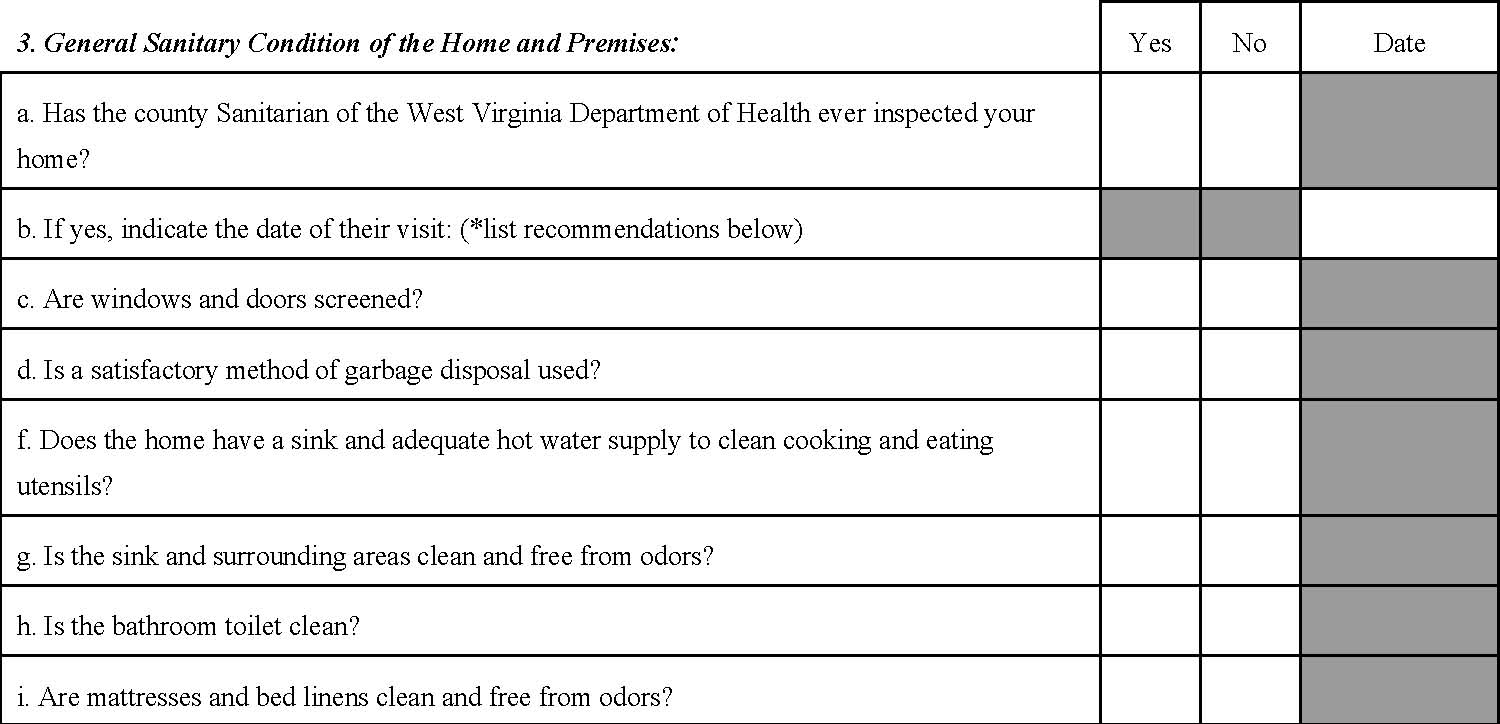
3. General Sanitary Condition of the Home and Premises: (continued)
Yes
No
Date
- j.
- Are adequate laundry facilities available?
- *List Recommendations of the WV Department of Health (if applicable - see 3-b above)
- Recommendations: (made by Adult Service worker to the provider)
- Overall sanitation status of the home: ( mark one)
| a. | Meets current standards .......................................................... | ||
|---|---|---|---|
| b. Not acceptable (if determined to be not acceptable, mark one of the following) | ........................ | ||
| 9 | If initial evaluation, and found “not acceptable”, deny application. | ||
| 9 | If current provider, see recommendations above. | ||
| Date Completed: | |||
| Reviewed By: | |||
| Title: | |||
Form - I
Homestudy Summary
AFC/ESC Homestudy Summary
I. Applicant Information:
Name: _____________________________________________________________ Phone #: ______________________________ Mailing Address:__________________________________ Physical Address:
Date Completed Completed By:
II. Residence (provide a description of the home in each of the following areas)
A. Neighborhood - describe location of the home:
| 9 | business | 9 | rural | 9 | evidence of pollution |
| 9 | factory | 9 | urban | 9 | evidence of crime |
| 9 | residential | 9 | other |
Additional Comments:
B. Accessibility - indicate if home accessible to the following:
9 church 9 recreational facilities 9 local Mental Health 9 stores 9 local DHHR 9 other
- By what means are these available? (car, bus, walking, etc)
- Describe community strengths
- Describe community limitations
- Additional Comments:
C. Describe exterior of the home & all buildings associated with it:
- Are premises well cared for? Yes _______ No _______
- Are there objects that could be dangerous present? Yes _______ No _______
- Is there yard space for recreation? Yes _______ No _______
- Are outside stairways handicapped accessible? Yes _______ No _______
- Are there animals on the grounds? Yes _______ No _______
a. If so, do they appear to be healthy & friendly? Yes _______ No _______
II. Are all vaccinations current? Yes _______ No _______
- Describe the general upkeep of the exterior of home:
- Additional Comments:
D. Describe interior of the home
- Total # of rooms _________________ Total # bedrooms __________________ Total # bathrooms __________________
- Location of Bedrooms
- Adequacy of furnishings
- Running water in all bathrooms? Yes _______ No _______
- Running water in kitchen? Yes _______ No _______
- Is water source approved? Yes _______ No _______
- Are wastes disposed of in sanitary manner? Yes _______ No _______
- Is there clutter that could prevent safe evacuation? Yes _______ No _______
- Is there adequate personal storage space for residents? Yes _______ No _______ (bedroom & bathroom)
- Are resident’s beds clean, firm & adequately furnished? Yes _______ No _______
- Is lighting adequate for reading & other activities? Yes _______ No _______
- Does the home have a basement? Yes _______ No _______
- If so, What is it used for?
- Applicant Name:
- Does the home meet fire & safety standards? Yes _______ No _______ (See Annual Fire & Safety Review)
- Does the home meet sanitation standards? Yes _______ No _______ (See Annual Sanitation Review)
- Describe the general upkeep of the home:
- Additional Comments:
- III.
- Arrangements for AFC Residents
- What rooms in home will residents be allowed?______________________________________________________________
- What rooms, if any, are off limits?________________________________________________________________________ Why? ______________________________________________________________________________________________
C. Furnishings in Resident Rooms
- Describe furnishings provided.
- Are they comfortable? Yes _______ No _______
- Are they usable and in good repair? Yes _______ No _______
- Are they clean and well maintained? Yes _______ No _______
- Are they adequate for resident’s needs? Yes _______ No _______
- Are they attractive? Yes _______ No _______
- If the answer was no to any #2 - 6 above, describe changes needed: ______________________________________________
D. Client’s Place in AFC Family
- Will resident be considered part of the family? Yes _______ No _______
- If no, explain.
E. Type of Resident Preferred by Applicant
- Does applicant understand that most residents have mental and/or physical limitations? Yes ______ No ______
- Does applicant understand that most residents require medication & treatment? Yes ______ No ______
- Are there certain qualities any household member can not tolerate? Yes ______ No ______
- If yes, explain:
- IV.
- Finances and Resources of Provider

Applicant Name:
2. Describe the employment history of the applicant and household members:
B. Property
I. Is the home: 9 Rented 9 Owned 9 Mortgaged
- II.
- If rented, can the applicant obtain a written statement from landlord that it is acceptable to operate as an Adult Family Care Home? Yes _______ No _______
- List medical insurance carried on each household member:
- Real Estate Insurance 9 Home Owners (specify carrier & limits) 9 Renters (specify carrier & limits) 9 Other (specify carrier & limits)
D. Transportation
- What is the applicant’s means of transportation?
- Is transportation dependable? Yes _______ No _______
- Is transportation available at all times? Yes _______ No _______ If no to #2 or #3, describe plan for meeting transportation needs:
E. Other Resources (specify - e.g. livestock, farm products, board paid by household members, etc)
F. Overall Financial Security
- Does family appear to be financially secure? Yes _______ No _______
- Will there be other household income (besides that paid by/for AFC residents)? Yes _______ No _______ (see “IV, A” above)
- Does household income cover all monthly household expenses (utilities, rent, food)? Yes _______ No _______
- If #3 is no, explain:
V. Applicant’s Family
A. Household Members
- Describe each household member:
- Is there any evidence of the following. If so, indicate family member & describe: 9 prejudice 9 over-sensitivity 9 irritability 9 explosiveness 9 peculiarities 9 unusual activities
| Name | Age | Appearance | Interests/Attitudes | Education/Social Activities | Significant Medical & Mental Health History |
|---|---|---|---|---|---|
Applicant Name:
9 other (specify)
B. Family Relationships
- Describe early life experiences of the family and impact of current functioning:
- If married, complete the following:
- Is the marital relationship a good one? Yes _______ No _______
- If no, explain:
- Does each partner appear to be happy and satisfied with their partner? Yes _______ No _______
- If no, explain:
- Has either partner been married previously? Yes _______ No _______
- If so, are there step children from the marriage(s)? Yes _______ No _______
- Does the applicant/couple have a good relationship with their children? Yes _______ No _______
- If there are conflicts, explain:
- Does the applicant/couple have a good relationship with other relatives? Yes _______ No _______
- If there are conflicts, explain:
- Is there/has there ever been a DHHR case involving this family (client or provider)? Yes _______ No _______
- If yes, explain:
- Additional Comments:
| C. | Family Attitudes |
| 1. | How do household members feel about having AFC clients living in their home? |
| 2. | How do relatives of the family, not in the household, feel about this arrangement? |
| 3. | Additional Comments: |
D. Relationship of Provider to Resident
- Is home being evaluated for a relative placement? Yes _______ No _______
- If, so does home meet criteria for placement of a relative? Yes _______ No _______
- Additional Comments:
E. Health Standards (see also - physicians statement)
- Is applicant and all household members free from communicable disease? Yes _______ No _______
- Is applicant physically able to care for adults placed in their home? Yes _______ No _______
- Is the applicant mentally/emotionally able to care for an adult(s) placed in their home? Yes _______ No _______
- Does any household member have a debilitating disease or illness? Yes _______ No _______
- Applicant Name:
- If yes, explain:
- Do all household members receive adequate medical care? Yes _______ No _______
- If no, explain:
- Additional Comments:
- f.
- Reasons for Becoming an AFC/ESC Provider
- VII.
- Ability to Care for Incapacitated Adults (describe how the applicant plans to address the following)
Explain:
C. Does the applicant recognize the challenges and satisfactions in caring for incapacitated adults? Explain:
D. How does the applicant feel about possible disturbances/difficulties that may occur in the home? Are there members of the household who already create disturbances/difficulties within the home?
Explain:
E. How will the applicant encourage resident cooperation? Will they encourage independence in residents? Explain:
F. What constitutes a “problem” for this family and how will they deal with problems when they occur? Explain:
G. Will the family assume responsibility for maintaining adequate clothing, providing transportation for medical care, supervision and care for the client?
Explain:
H. How will client be introduced in the community and veiwed/received by neighbors? Any objections to having an incapacitated person in the neighborhood?
Explain:
I. Will the provider be able to recognize and handle emergencies? Explain:
VIII. Results of the CIB
Applicant Name:
A. Summarize the results of the CIB for each household member.
B. Was a waiver requested? Yes No
C. If yes, provide justification:
| IX. A. | References Summarize the results of all written references: | |
|---|---|---|
| Personal Reference: NameResults: | Relationship to Applicant | |
| Personal Reference: NameResults: | Relationship to Applicant | |
| Credit Reference: NameResults: | Relationship to Applicant | |
| B. | Summarize the results of the face to fact reference contact (at least 1 required) Reference: NameResults: | Relationship to Applicant |
| Reference: NameResults: | Relationship to Applicant | |
| X. | Evaluation of Home and Recommendations: | |
| A. | Specify strengths & weaknesses: | |
B. Are there certain types of adults this provider could handle better than others? Explain.
C. Are there certain types of adults that could definitely not be placed in this home? Explain.
D. Are there racial and/or nationality factors that should be taken into consideration? Explain.
E. Does the home meet all standards for an Adult Family Care Home? Yes No
F. If #5 is no, what are the deficiencies and their effect on approval of the home?
Applicant Name:
G. Is this home being recommended for approval as an AFC? Yes No As an ESC? Yes No_____ As a Combination AFC/ESC? Yes No_____
H. If yes, indicate how many adults the provider will be able to adequately care for: Additional Comments:
Form - J
Provider Agreement for Participation
WEST VIRGINIA DEPARTMENT OF HEALTH AND HUMAN RESOURCES ADULT EMERGENCY SHELTER CARE PROVIDER AGREEMENT FOR PARTICIPATION
Provider Name Address: Telephone Number:
I, , agree to provide Emergency Shelter beds. (provider name)
As a provider of Adult Emergency Shelter Care, I further agree to the following:
- To participate in a minimum of six (6) hours of pre-service training, and two (2) hours of ongoing training every three (3) months;
- To accept any eligible adult being placed by the Department of Health and Human Resources regardless of age, gender, race, religion, creed or national origin;
- To provide care and services to persons placed in my home until such time as a suitable plan for the client is developed and alternate living arrangements are agreed upon;
- To render special care and services to persons placed in my home according to the needs of the individual;
- To permit the Department of Health and Human Resources to visit my home, talk with the client(s) in private, and make unannounced visits;
- The client(s) placed in my home shall not be removed from my home or transferred to another home without approval of the Department of Health and Human Resources;
- To immediately notify the Department of Health and Human Resources of any serious and/or contagious family illness and/or changes in members of the household;
- To immediately notify the Department of Health and Human Resources of any illness or accident involving the client(s) placed in my home;
- To have an adult available in the home at all times who is authorized to admit and provide care for clients;
- To not have more than the number of clients for which my home is approved in residence at one time;
- To allow the client(s) to have visitors;
- To immediately refer all complaints to the Department of Health and Human Resources;
- Not to accept payment for care from the client, relatives and/or other individuals without approval of the Department of Health and Human Resources;
- To cooperate with the Department of Health and Human Resources in carrying out the client’s service plan including returning the client to his/her own home, or placement in another appropriate setting; and
- To provide or arrange for transportation of the client to medical appointments or to obtain medications prescribed by the client’s physician.
I understand that the Department of Health and Human Resources will:
- Provide or arrange for a minimum of six (6) hours of pre-service training and two (2) hours of ongoing training every three (3) months;
- Develop and implement a service plan, within thirty (30) days of placement, for each client placed in my home;
- Provide a monthly subsidy payment in the amount of $ for each contracted Emergency Shelter bed;
- Provide reimbursement for room and board for each client placed in my home in the amount of $ per client. This per diem shall include the date of placement and exclude the date of discharge; and
- Not intentionally place an ineligible person in Emergency Shelter Care.
I understand that any deviation from the terms set forth above shall be cause for immediate termination of this agreement.
I certify that I have read the above statements and agree to accept placement of individuals for Adult Emergency Shelter Care under these provisions.
WEST VIRGINIA DEPARTMENT OF HEALTH AND HUMAN RESOURCES
BY
(DHHR Representative Name) (Date)
Title
ADULT EMERGENCY SHELTER CARE HOME PROVIDER
BY
(Provider Name) (Date)
Form - K
Insurance Loss Notice
INSURANCE LOSS NOTICE -State of West Virginia ! BRIM USE ONLY !
Instructions: For all losses, complete sections 1,2,& 3 ! Coding / / For Auto losses -also section 4 ! To. Co. For Insured Property losses -also section 5 !
(1) Insured Name: Insured Account # (required)
Insured Address:
Insured Phone Number (day):
Contact Person: Position with Insured:
For Insured (Contact Person)
(2) Date of Loss: Time of Day:
Location of Occurrence: (Street address)
Description of Occurrence:
Investigated By: (Police, Fire, etc.)
III. Injured/Property Damaged
Name: (injured/owner)
Address:
use additional sheet(s) as necessary Home Phone #: Work Phone#:
Age Sex Social Security #:
Employer:
Description-Injury:
Description-Property Damage:
--Occupation: Where is Property Now?
Estimate Amt. $
Witnesses:
D. Auto Losses Only
Insured Vehicle Year Make Model VIN
use additional sheet(s) as necessary
Claimant Vehicle Year Make Model VIN
Vehicle Driver Vehicle Driver Vehicle Owner Vehicle Owner Passengers Passengers
E. Insured Property Losses Only: Loss Type ( ) Fire ( ) Windstorm ( ) Burglary & Theft ( ) Boiler & Machinery ( ) Fidelity ( ) Vehicle ( ) Aircraft ( ) Other
SUBMITTED BY: DATE:
West Virginia Board of Risk & Insurance Management * 4501 MacCorkle Ave., S.W. Suite 300, So. Charleston, WV 25309
Applicant Name:
(304) 766-2646 * (800) 345-4669 * (304) 766-2653
AFC/ESC Homestudy
Page 101 of 122
Form - L
Approval Letter

| STATE OF WEST VIRGINIA | ||
|---|---|---|
| DEPARTMENT OF HEALTH AND HUMAN RESOURCES | ||
| Bob Wise | Bureau for Children and Families | Paul Nusbaum |
| Governor | Secretary | |
| Date: | ||
Dear :
We are pleased to advise you that your home has been approved to provide Emergency Shelter Care for up to adults. A review of your home will be completed yearly to renew this approval. Should approval be discontinued, you will be notified in writing. The approval of your home as an Emergency Shelter Care provider verifies that you have met all applicable requirements of the Department of Health and Human Resources. We welcome you as a member of the Emergency Shelter Care program and we believe that your experience in the program will be a rewarding one.
A Social Service worker from the Department of Health and Human Resources will visit your home in the near future to present you with a “certificate of approval” as an Emergency Shelter Care provider. During that visit they will also discuss the next steps in the Emergency Shelter Care process with you. This social service worker will work with you to arrange for placement of each adult who will be placed in your home. Additionally, they will provide helpful information about the care of the adult placed with you.
Please feel free to contact us at (304) to request services and/or information. In the event of an emergency, please notify your social service worker immediately. Sincerely,
(Name)
(Title)
Form - M
Certificate of Approval

Form - N
Re-Certification Letter

| STATE OF WEST VIRGINIA | ||
|---|---|---|
| DEPARTMENT OF HEALTH AND HUMAN RESOURCES | ||
| Bob Wise | Bureau for Children and Families | Paul Nusbaum |
| Governor | Secretary | |
Date:
ADULT EMERGENCY SHELTER CARE RE-CERTIFICATION
Dear :
We are pleased to advise you that your approval to maintain an Adult Emergency Shelter Care home has been extended for another year. The review which was recently conducted verified that you continue to meet applicable requirements for continued participation in the program.
We realize that your provision of Adult Emergency Shelter Care is an extremely challenging endeavor. Your interest in caring for elderly and disabled adults is commendable. We look forward to continued support of you in your efforts to provide quality care.
Please contact me at (304) if I may be of assistance.
Sincerely,
Social Service Worker
Form - O
Negative Action Letter
WEST VIRGINIA DEPARTMENT OF HUMAN SERVICES
Dear
This letter is to notify you of action taken on your application for social services. Please refer to the item(s) checked below to indicate what action was taken.
- () Your application for has been approved.
- () Your application for has been denied because :
- . Please refer to the information on the back of this letter concerning your right to a conference or hearing.
- () The fee for the service you receive is per .
- () You are no longer eligible for after because
Please refer to the information on the back of this letter concerning your right to a conference or hearing. If you have a concern or complaint about the quality of service you are receiving or whether the service is meeting your needs, please
contact me about the Department of Human Services’ grievance procedure. In addition, your right to a conference concerning the
decision shown above and your right to a hearing are explained on the back of this letter.
Should you have any questions, please contact me.
Sincerely,
Signature of Worker Date REQUEST FOR A CONFERENCE REGARDING THE PROPOSED ACTION TAKEN ON YOUR APPLICATION
If you are not satisfied with the proposed action to be taken on your application or need further explanation, you have a right to discuss it with the Department worker who made the decision. If you are not satisfied with the results of this conference, you may wish to request a hearing.
REQUEST FOR A HEARING BEFORE A MEMBER OF THE STATE BOARD OF REVIEW
If you are not satisfied with the decision made on your application, you have the right to a hearing before a State Hearing Officer who is a member of the State Board of Review.
THE LENGTH OF TIME YOU HAVE TO REQUEST A CONFERENCE OR HEARING
If you wish a conference, please contact this office at once. If you wish a hearing, you must notify this office within ninety (90) days from the date of the action. You may request a conference or hearing by contacting this office in person or by completing the statement at the bottom of this letter. Detach it and mail the request to this office.
CONTINUATION OF SERVICES DURING THE HEARING PROCESS
If you request a hearing within thirteen (13) days of this notice, services may be continued or reinstated pending a decision by the State Hearing Officer.
WHO MAY HELP YOU AT THE CONFERENCE OR HEARING
At the conference or hearing, you may present your information yourself or in writing. You have the right to be represented by a friend, relative, attorney, or other spokesperson of your choice. A Department representative will be available to assist you if you need help in preparing the hearing and advise you regarding any legal service that may be available in your community.
-----------------------------------------------------------------------------(DETACH)------------------------------------------------------------------------
IMPORTANT !!
If you want a conference or hearing, please check one of the blocks below and mail this statement to:
(__) I want a pre-hearing conference because:
(__) I want a hearing before the State Hearing Officer because: Signature of Claimant: Date: (PLEASE DATE AND SIGN)
Form - P
Social Evaluation
WEST VIRGINIA DEPARTMENT OF HEALTH AND HUMAN RESOURCES SOCIAL EVALUATION
I. IDENTIFYING INFORMATION
A. Client Name B. Marital Status
C. Current Address D. Religious Preference
E. F. Social Security #
G. Date of Initial Request
H. Relative or Other Contact Person
I. Attending Physician (name) (address) (telephone #)
J. Burial plans
K. Medical and/or Life Insurance
| Name of Company | Policy Number | Face Value |
|---|---|---|
B. SOCIAL EVALUATION
- a.
- Explanation of why services are being requested at this time:
2. MENTAL/COGNITIVE CONDITION Alert Irrational Behavior Diminished mental awareness
Up in chair - transfers independently Confused
Up in chair - dependent to transfer Comatose
Bedridden Comments:
Comments:
| 3. | EATING | 4. | BOWEL/BLADDER CONTROL |
| Eats independently | Completely continent | ||
| Feeds self with help | Partially incontinent | ||
| Must be fed | Catheter in use | ||
| Comments: | Incontinent |
Comments:
e. MEDICATIONS: Self-Administered Yes No (list each) Name of Medication Dosage Frequency Prescribing Physician
6.
ACTIVITIES OF DAILY LIVING (Current Functioning) Independent
Dependent
With Help Bathing Dressing Care of Home Food Preparation (Including purchasing)
| 7. | INDIVIDUAL CHARACTERISTICS | ||||
|---|---|---|---|---|---|
| a. Temperament - Personality Traits | |||||
| b. Employment History | |||||
| c. Education | |||||
| d. Recreation, Hobbies and Interests | |||||
| C. | HABITS | ||||
| (1) Tobacco | (2) Alcohol/Drugs) | (3) Food | (4) Sleeping | (5) Personal Hygiene | |
| Comments: | |||||
D. SPECIAL DISABILITIES (Check all that apply)
| Impaired Vision | Paralysis | Amputation | |||
| Blind | Speech Impair. | Fractures | |||
| Deaf | External Ulcers | Deformities | |||
| Other (specify) | Other (specify) | Other (specify) |
E. FORMAL/INFORMAL SUPPORT(S) AND LIVING ARRANGEMENTS Explain relationships; ability of relatives, friends, neighbors to assist client. Also explain client’s refusal to receive services when appropriate.
III. ASSESSMENT OF TYPE CARE/SERVICES NEEDED (check all that apply)
A. The following alternatives have been considered for this individual:
| Personal Care Serv. | Day Care | Pers. Care Home | |||
| Meals on Wheels | Phone Reassurance | RB&C Home | |||
| Congregate Meals | Friendly Visitor | Nursing Home | |||
| Homemaker | Care in Rel. Home | Group Home | |||
| Home Health | Adult Family Care | Institutional Care | |||
| Other (specify) | Other (specify) | Other (specify) |
B. I have concluded that the appropriate Social Services plan for this individual is For the following reason(s):
IV. ACTION WHEN SOCIAL SERVICE PLAN IS SUPERVISED CARE
A. General Information
- Date of Admission: 2. Level of Care: AFC RB&C PCH Inst
- Provider Address:
- Client Income will be managed by: Self Provider Other (specify on line below) Name: Address : Phone:
- Personal Expense Allowance will be managed by: Self Provider Other (specify on line below) Name: Address : Phone:
B. Client entered supervised care in another area
1. Contact with receiving area made (date) Name and Title of staff person contacted
Applicant Name:
2. If contact made after admission, explain
Additional Comments:
Signature of Social Worker Date Completed
Form - Q
Payment Agreement
WEST VIRGINIA DEPARTMENT OF HEALTH AND HUMAN RESOURCES ADULT EMERGENCY SHELTER CARE HOMES
PAYMENT AGREEMENT
This is to advise that , has been approved for
(client name)
Emergency Shelter Care in the home of . In addition
(provider name)
to the monthly subsidy payment, the provider will receive a boarding care payment in the amount
of $ per day, including the date of placement and
(date of placement)
excluding the date of discharge. Any deviation from the conditions agreed to in the Provider Agreement for Participation shall be cause for termination of this agreement.
Social Service Worker: Date:
AGREEMENT FOR RECEIPT OF EMERGENCY SHELTER CARE
I, , agree to placement in the home of
(client name)
, for Emergency Shelter service until alternate arrangements may be
(provider name)
made for my care. I understand that this placement is temporary in nature and may not exceed a maximum of thirty (30) days in a twelve month period.
Client Signature: Date:
AGREEMENT FOR PROVISION OF EMERGENCY SHELTER CARE
I agree to provide Emergency Shelter Care for to
(client name)
include room, board, personal services and supervision at the rate indicated above and in accordance with the terms set forth in the Provider Agreement for Participation.
Provider Signature: Date:
Form - R
Annual Review Summary
AFC/ESC Annual Provider Review Summary
I. Applicant Information:
Provider Name: Date Completed:
Address: Completed By: Telephone: FACTS ID:
II. Address each of the following areas: (indicate n/a for any sections that are not applicable)
A. Changes in family/household composition:
B. Changes in household financial resources:
C. Changes in health of the provider and/or other household members:
D. Provider’s description of the experience of being an AFC/ESC provider:
E. Client(s) adjustment to the home:
F. Provider’s ability to adequately care for the needs of clients placed in their home:
G. Provider’s cooperation with the Department:
H. Complaints received regarding the home:
I. Changes in location of the home:
J. Review of expectations and requirements of providers and how provider does/does not meet these:
K. Goals for the upcoming year:
L. Recommendations for continued use:
III. Update the following forms:
Physician’s Letter Annual Sanitation Review Annual Fire and Safety Review Others required due to change in circumstances - specify Letter of Re-Certification Sent
IV. Additional Comments:
Date Completed:
Date Completed:
Date Completed:
Date Sent:
Date Completed:
Date Completed:
Form - S
Adult Residential Services
Corrective Action Letter
Bureau for Children and Families West Virginia Department of Health and Human Resources
(enter DHHR mailing address)
(enter DHHR city, state & zip)
Telephone: (304) (enter DHHR phone #) FAX: (enter DHHR fax #)
(Enter date notification sent)
(Enter name of facility administrator/operator being notified)
(Enter Facility name )
(Enter mailing address)
(Enter city, state & zip)
Dear (Enter name of person to whom notification being sent):
The Department of Health and Human Resources recently completed a review/site visit of your home/facility. During that visit, the following areas or concern were identified. Therefore, we are hereby advising you that you must prepare a Corrective Action Plan to address the areas of concern identified below:
(Enter all findings that must be addressed in the Corrective Action Plan)
The Corrective Action Plan is due to this office within 15 days following receipt of this notification. At a minimum, the Corrective Action Plan must: 1) address all the issues identified, 2) clearly identify the specific actions that are to be taken to correct the problem(s), 3) identify who is responsible for carrying out each task, and 4) specify the time frames for completion of each task.
DHHR District Address: Sincerely,
(Enter DHHR mailing address)
(Enter mailing address) Name: (Enter social worker's name
(Enter mailing address)
Title: (Enter social worker's title)
Form - T
Authorization for Medical
Service for Adults
(SS-AS-001)

STATE OF WEST VIRGINIA DEPARTMENT OF HEALTH AND HUMAN RESOURCES
Bob Wise Paul Nusbaum Governor Secretary
AUTHORIZATION FOR MEDICAL SERVICE FOR ADULTS
NAME: DOB: SSN: / / ADDRESS:
(Residence, Facility)
This is to certify that the above named person has NOT been approved, nor has a pending application for a Medicaid medical card but is eligible for necessary medical services from the department of Health and Human Resources. This letter authorizes the use of ___________________________________ ONLY for the following
(Medicaid Billing #) MEDICAID ALLOWABLE service and is valid for up to , but not more than sixty (60) days from the date of authorization with the exception of pharmaceutical purchases to maintain elderly and/or disabled adults placed by
the Office of Social Services which may be authorized for up to twelve (12) months. Months authorized for pharmaceutical purchases ___________________________________________________________________________________.
A copy of this letter MUST be attached to all medical invoices submitted for payment from state funds. Invoices submitted without this letter will be returned to the medical provider.
SERVICE AUTHORIZED:
| Authorized Signature | Date | ||
| (Office of Social Services) | |||
| * * * | |||
| SS-AS-001 | |||
| (4-15-94) |